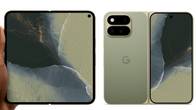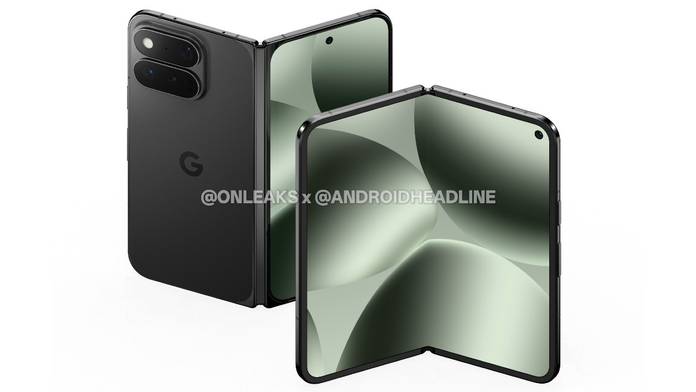
The Google Pixel 11 Pro Fold launch might be months away, but its design is already out in the open. Popular tipster OnLeaks has collaborated with Android Headlines to share CAD-based renders of the smartphone, revealing its design from every angle. It appears the device will not come with any meaningful changes to the design compared to its predecessor, the Pixel 10 Pro Fold (review).
That said, the Pixel 11 Pro Fold is reported to be thinner than ever before and boasts nothing but two protruding oblong-shaped cameras on the squircle module at the back. While there is no word on the structural integrity of the smartphone, we hope it is better than the Pixel 10 Pro Fold, which, despite being IP68 rating, couldn’t survive the bend and fold test in one video.
The reported CAD renders are 2D images created from a 3D model. Google has neither teased nor confirmed the smartphone yet, suggesting the tipster may have gained early access to design files or information related to the device. While the source has a fairly reliable track record with previous leaks, it is still advisable to treat this information with a grain of salt.
The Pixel 11 Pro Fold is reportedly set to feature an 8-inch foldable LTPO OLED display with a dynamic 1Hz–120Hz refresh rate. The inner display appears to include a corner-aligned punch-hole cut-out for selfies, along with slim and evenly sized bezels on all sides. On the outside, the device is said to sport a 6.4-inch LTPO OLED cover display that also supports a dynamic refresh rate of up to 120Hz. Google is expected to retain curved corners on the outer screen, along with a centred punch-hole cut-out for the front camera and relatively slim bezels surrounding the panel.

This means the Pixel 11 Pro Fold will measure almost the same as its predecessor in terms of its height and width, both while folded and unfolded. For those unaware, it is 155.2 x 150.4 while unfolded and 155.2 x 76.3 in the folded state. However, the upcoming foldable from Google will be thinner, with just 4.8mm in thickness when used in tablet form, and 10.1mm when converted into a smartphone. Even if these dimensions hold true, it won’t be as slim as the Samsung Galaxy Z Fold 7, which measures 158.4 x 143.2 x 4.2 mm (unfolded) and 158.4 x 72.8 x 8.9 mm (folded).
There is no word yet on the weight of the Google Pixel 11 Pro Fold. However, the renders suggest the rear cameras will not sit flush within the aluminium module on the back. Instead, the lenses appear to be housed in two protruding oblong-shaped cut-outs on the camera island, with the LED flash integrated into the top section of the module rather than placed outside it. It will be the only notable change to tell the smartphone apart from its predecessor that has come up so far.
Every other aspect of the phone, including the charging port, microphone, speaker grille, aluminium chassis, and glass cover, is expected to remain unchanged.

The renders confirm three camera sensors on the platform. It remains to be seen whether those will be identical to the Pixel 10 Pro Fold or not. However, like every year, the handset will get a bump in performance with the Tensor G6 chipset ticking at its core, aided by 16GB RAM and up to 1TB storage onboard. Interestingly, it is reported that the Pixel 11 Pro Fold may come with a marginally smaller 5,000mAh battery as opposed to the 5,015mAh on its predecessor. This is unlikely to bring any difference in the backup of the devices in the real world, but it is a bummer to see the successor with a smaller battery pack at a time when others are pushing for larger ones.
That’s all we know about the Pixel 11 Pro Fold so far. We’ll have to wait for more details to determine whether the smartphone will be worth the wait. In case you are looking for a foldable right now, the Samsung Galaxy Z Fold 7 (review) is worth checking out for its slim design, relatively powerful chipset, capable cameras, and promising software support.