OnePlus N6 launching soon as the company’s cheapest phone: 4 things we want to see


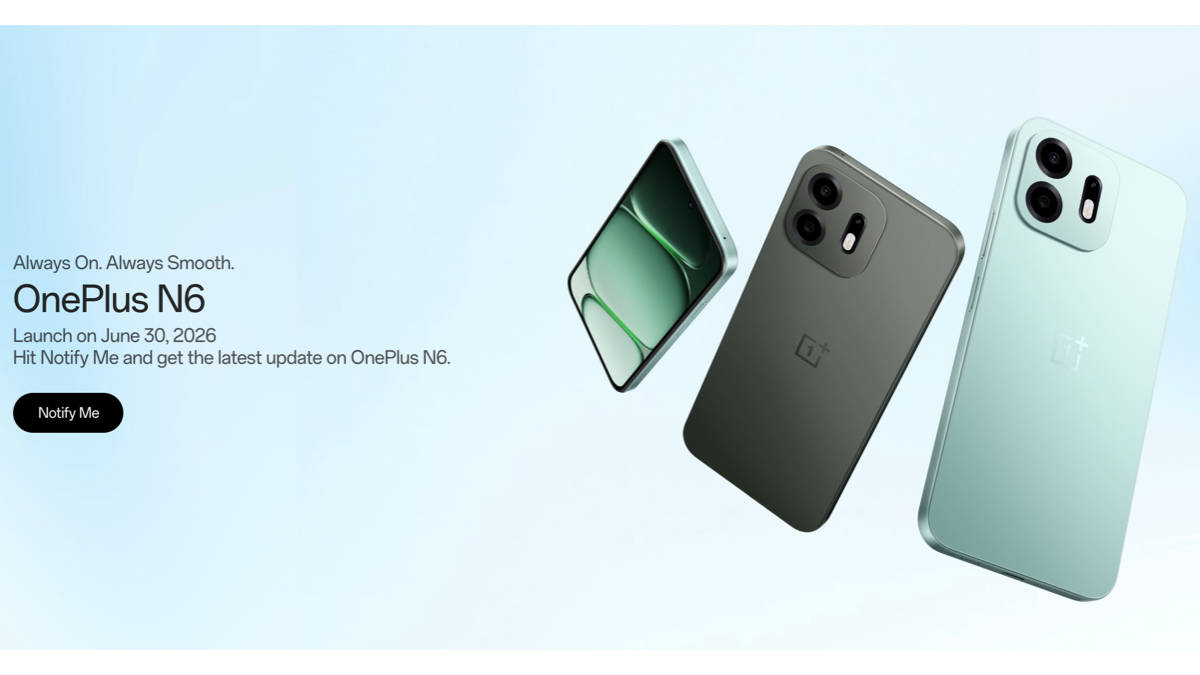
For years, OnePlus built its reputation around affordable “flagship killers”, which was incidentally the tagline for the company’s first-ever phone, the OnePlus One, launched in 2014 at Rs 21,999. However, in the last couple of years, the company has steadily moved upmarket. Its latest flagship, the OnePlus 15, sits comfortably in premium territory at Rs 85,999, while even some Nord models have crept into premium mid-range price brackets that would have seemed ambitious a few years ago. That’s what makes the launch of the OnePlus N6 (on June 30th) interesting.
The company has expanded its portfolio over the years and recently exited the sub-Rs 25,000 segment by raising prices on the OnePlus Nord CE 6 Lite. Ironically, in today’s day and age, the segment can appropriately be labelled “budget”. The OnePlus N6, expected to launch under Rs 25,000 (some reports even claim a sub-Rs 20,000 pricing), could become the company’s first genuinely budget-focused smartphone in a long time. And if the company gets it right, it could help reconnect with a segment of buyers that helped make the brand popular in India in the first place.
So far, OnePlus has revealed only the phone’s design, not its specifications. Here are our expectations from the phone, which, in today’s era of rising prices, could feel like a breath of fresh air for consumers shopping in the sub-Rs 25,000 segment.
Table of Contents
Performance that shouldn’t feel “budget”
The sub-Rs 25,000 segment is, at this point, more competitive than ever. Competing phones include the Redmi 15, POCO M8, Nothing Phone (3a) Lite, Infinix Note Edge, Realme P4 series, and maybe upcoming phones from the iQOO Z11 series. Most OEMs have been trying to offset rising memory component prices by taking a hit in the chipset department. At one point, processors popular in budget phones were now appearing in upper mid-range devices around the Rs 30,000 price point.
Historically, OnePlus phones have remained performance leaders in their segments, especially the Nord lineup. With the OnePlus N6, the company doesn’t necessarily need the fastest chipset in the category for the budget consumer. What it does need is consistency. Smooth day-to-day performance, reliable multitasking and stable gaming matter more than benchmark scores for most buyers. If the N6 can avoid throttling issues and maintain OnePlus’ traditionally fluid software experience, it will have a strong foundation.


Software support should be a priority
For many consumers, software support has become as important as a phone’s performance. Especially with rising prices, consumers are unlikely to upgrade their phones every two years, which is essentially the OS support brands are offering in the lower-price segments. Samsung has made longer update policies a major selling point, even in lower-priced segments, while Nothing has also focused heavily on software longevity. The POCO M8, currently available around Rs 20,000, gets four years of OS updates and six years of security updates. To gain a competitive advantage, the N6 would benefit from at least three Android OS updates and four years of security patches. For context, the OnePlus Nord CE 6 Lite gives two years of OS and four years of security updates.
A camera that gets the basics right
This is where many affordable phones lose their way. Instead of loading the spec sheet with multiple low-value sensors, OnePlus would be better served investing in a strong primary camera. Good daylight photos, reliable HDR processing and dependable low-light performance will matter far more than a decorative macro camera. Nothing and Motorola have shown that buyers increasingly care about image quality rather than camera count.
Battery life that sets a benchmark
As performance in the sub-Rs 25,000 has taken a hit, battery life has been the big gainer. We expected OnePlus to not disappoint with the N6 going by their recent launches, and they haven’t. The company has officially revealed the OnePlus N6 will come with an 8,000mAh battery, which is the same capacity as the OnePlus Nord CE 6. The OnePlus Nord CE 6 Lite offers a 7,000mAh battery, which meets the unofficial baseline set for smartphones these days. However, in this segment, we have a phone with a massive 10,000mAh battery, the Realme P4 Power. We’re not saying OnePlus needs to beat that figure, but a well optimised smaller battery can even yield comparable results.
The N6 arrives at an interesting moment for OnePlus. The company has spent the last year raising flagship prices, with recent increases making devices significantly more expensive than at launch. A well-priced budget phone could help balance the portfolio while introducing younger buyers to the OnePlus ecosystem.
For prospective buyers, the biggest thing to watch will be the pricing. If OnePlus can keep the N6 below Rs 25,000 and tempt with some launch offers to bring it closer to Rs 20,000, while delivering clean software, dependable performance and excellent battery life, it may have its most compelling mass-market phone in years.