Vivo T4 Pro brings periscope zoom and four years of Android updates to the mid-range at Rs 27,999


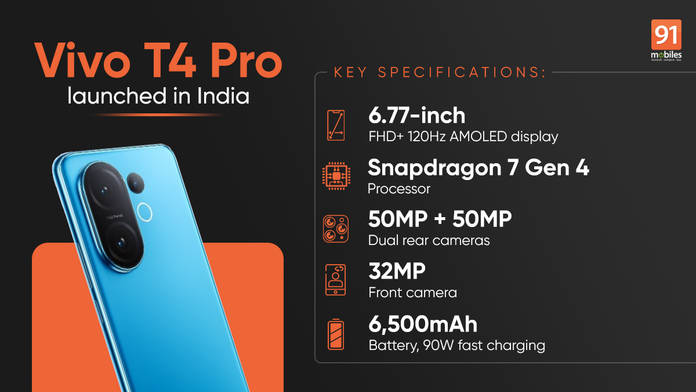
Vivo is on a launching spree with its T4 lineup, spanning the budget to mid-range market. The company has now introduced the Vivo T4 Pro, the sixth T4 handset this year. With models ranging from the T4 Lite at Rs 10,999 to the T4 Ultra at Rs 37,999, Vivo is filling nearly every slot in its portfolio. The latest T4 Pro arrives in the Rs 25,000–30,000 range, which had been missing in the series. Although the numerous T4 phones may cause some confusion for buyers, it appears to be paying off for Vivo, as the brand continues to lead India’s smartphone market by shipments, as per a recent IDC report. Also, by covering every price tier, it seems like Vivo wants to ensure buyers stay within its ecosystem instead of jumping to a rival brand.
Vivo T4 Pro stands out as the brand’s first phone with a 3x periscope camera in this segment. It’s a 50MP periscope camera with 3x optical zoom, which will be beneficial for capturing distant objects with better clarity. There are only a handful of phones offering a periscope camera in this price segment, and some of these include the Motorola Edge 60 Pro and the Nothing Phone (3a) Pro. For most users, the periscope lens will be more of a bragging point than a daily driver feature, but it signals Vivo’s intent to democratise flagship hardware.
Show Full Article
The Vivo T4 Pro also offers 10x telephoto stage portrait zoom, which is said to be ideal for stage performances at music festivals, roadshows, and small concerts. A 50MP primary camera with OIS accompanies this. For selfies, you get a 32MP front camera on the Vivo T4 Pro.


Under the hood, the Vivo T4 Pro is powered by the Qualcomm Snapdragon 7 Gen 4, a mid-range chipset introduced in May this year. Qualcomm claims it delivers 27 percent faster CPU speeds, 30 percent stronger GPU performance, and 65 percent better AI efficiency than its predecessor, the 7 Gen 3. For context, the Vivo T3 Pro ran on the 7 Gen 3, and we found its performance to be quite reliable for both everyday use and gaming. Interestingly, the Realme P4 Pro also features the Snapdragon 7 Gen 4 but comes in at a lower price of Rs 24,999. We’ll be putting the T4 Pro through its paces soon to see how it performs in real-world scenarios.
In terms of design, the Vivo T4 Pro looks more like the recently launched Vivo V60. The resemblance is apparent with the vertically aligned cameras and the same gold colour as well. The T4 pro also has a quad-curved display, which is a 6.77-inch FHD+ (2392 × 1080) AMOLED panel with a 120Hz refresh rate, 1,500 nits high brightness mode, and HDR10+. The quad-curved AMOLED with HDR10+ means binge-watching Netflix or gaming will feel more immersive. The smartphone comes in two colours: Nitro Blue and Blaze Gold, and is IP68+69 rated for dust and water resistance.

The Vivo T4 Pro also packs a 6,500mAh battery with 90W fast charging support. The 6,500mAh battery should comfortably last heavy users over a day. This is a pretty good setup for this price segment, although there are phones like the Realme 15 and OPPO K13 Turbo Pro offering a larger 7,000mAh battery. The handset runs Funtouch OS 15 based on Android 15 out of the box. It will receive 4 Android upgrades and 6 years of security updates, making the Vivo T4 Pro one of the only phones in the segment to offer such long support.
Vivo T4 Pro is priced at Rs 27,999 for the base 8GB + 128GB model. It comes in two more variants with the 8GB + 256GB model priced at Rs 29,999, and the top-end 12GB + 256GB variant priced at Rs 31,999. The smartphone will be available on August 29th via vivo.com, Flipkart, and offline stores.
With this launch, Vivo now has a T4 option in nearly every bracket. But the T4 Pro is clearly targeted at users who want zoom photography and premium touches without paying flagship money. So, if you’ve always wanted a periscope zoom in the sub-Rs 30,000 segment, the Vivo T4 Pro is one of the only phones that delivers it today.
The Vivo T4 Pro isn’t just another T-series filler. By pushing a periscope camera, curved AMOLED, and long software support under Rs 30,000, Vivo is trying to raise the bar for what mid-range buyers expect. But in a segment crowded with strong options from Realme, Nothing, and OPPO, the real test will be whether these specs translate to better experiences, not just marketing milestones. Our full review will tell if Vivo has pulled that off.