Xiaomi 18 Pro series confirmed with dual 200MP cameras and Galaxy S26 Ultra-like privacy display



Vivo kicked off the flagship season yesterday with the launch of the X500 series and OPPO is following today with the debut of the Find X10 phones. In the same week, Xiaomi also unveils its headliners and in a bid to differentiate, the company is putting cameras and display privacy at the centre of its next flagship generation. The Xiaomi 18 Pro and Xiaomi 18 Pro Max are set to launch in China on September 23rd, with the company confirming a Leica dual 200MP camera system and a hardware-level privacy display ahead of the launch.
Xiaomi 18 Pro, Pro Max cameras detailed
The camera setup on the Xiaomi 18 Pro phones pairs a 200MP main camera using a large 1/1.28-inch sensor with a 200MP periscope telephoto featuring a 1/1.56-inch sensor. The telephoto has an f/2.4 aperture, a native 75 mm focal length, 3.2x optical zoom and up to 12.8x lossless zoom. Its floating dual-lens focusing system can focus as close as 12cm, allowing the telephoto to also be used for macro photography.
Show Full Article

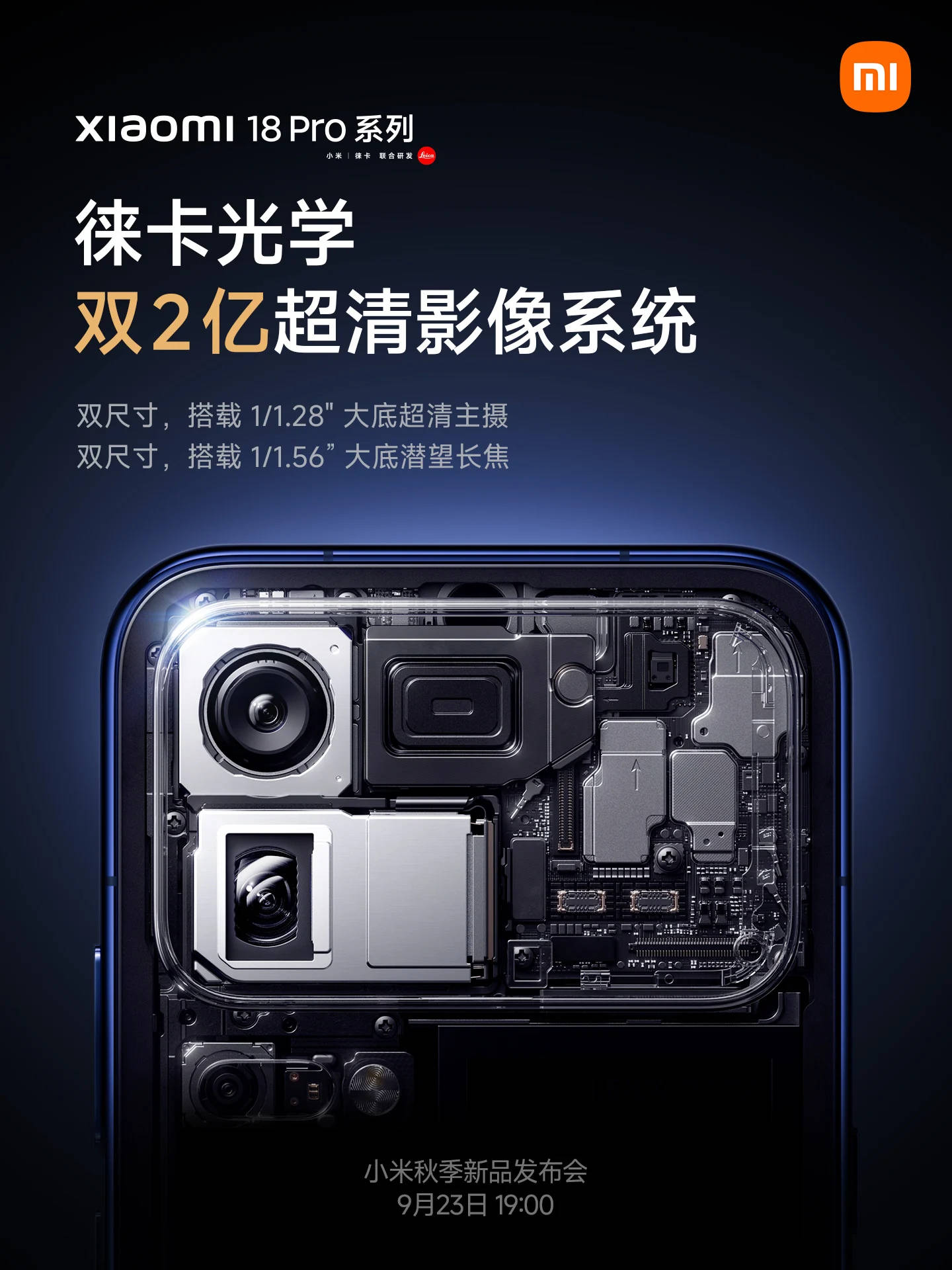
Xiaomi says the telephoto’s light intake has increased by 280 percent on the Xiaomi 18 Pro compared with its predecessor, while the Xiaomi 18 Pro Max gets an 83 percent increase. The combination of a large sensor and 200MP resolution gives Xiaomi’s new phones a particularly high-resolution setup for both standard and zoom photography.
For comparison, Samsung’s Galaxy S26 Ultra uses a 200MP main camera alongside a 50MP telephoto. Xiaomi is putting the same 200MP resolution on both of its key cameras, although that alone doesn’t determine image quality. Processing, stabilisation and sensor performance will still play a role in how the cameras perform in real-world use.
The Xiaomi 18 Pro series will also feature a secondary rear display, although Xiaomi hasn’t yet revealed the full set of functions it will offer but its speculated to be tied to AI generation.
Xiaomi 18 Pro privacy display
The other major feature is Super Pixel Display 2.0, which brings hardware-level privacy protection to the phones. Samsung introduced this with the Galaxy S26 Ultra, which featured a built-in Privacy Display designed to restrict what can be seen from an angle. Xiaomi’s implementation uses two sets of pixels, including dedicated privacy pixels with physical baffles that restrict their beam angle. When privacy mode is activated, the standard pixels switch off and the privacy pixels remain active. Xiaomi says brightness can fall to around 1 percent when viewed beyond 60 degrees, making the screen difficult for people beside the user to see.
Users can activate the feature through Quick Settings, a customisable AI key or Xiao AI voice controls. It can also be configured for individual apps, pages and locations. The front camera can reportedly detect someone looking over the user’s shoulder and automatically warn the user or darken the sides of the display.
The technology is now spreading beyond Samsung. Huawei has also introduced a hardware-based privacy display on the Mate XT 2 foldable, showing that display privacy is emerging as another area of contention.
Specifications and availability
The Xiaomi 18 Pro and Pro Max will pack 7,000mAh and 8,500mAh batteries, respectively, with support for 100W wired and 50W wireless charging. Their displays use Xiaomi’s new Super Pixel Display 2.0 with M11 light-emitting material, while the bezels have been reduced to 0.99mm, compared with 1.18mm on the previous generation. The panel can reach up to 4,000 nits and supports BT.2020 colour gamut coverage.
The two phones will use different versions of the Snapdragon 8 Elite Gen 6, with the Pro getting the Snapdragon 8 Elite Gen 6 and the Pro Max receiving the higher-tier version.
Xiaomi has confirmed the China launch for September 23rd, but pricing and global availability remain unannounced. There is also no word on an India launch. The Xiaomi 17 Pro and 17 Pro Max were not launched in India, so buyers here should wait for Xiaomi to confirm its plans rather than assume the new Pro models will arrive. For those considering a flagship camera phone, the dual 200MP cameras and built-in privacy display are the two features worth watching when the full specifications and pricing are revealed.