Best gaming phones under Rs 60,000: expert picks for best performance, battery, software


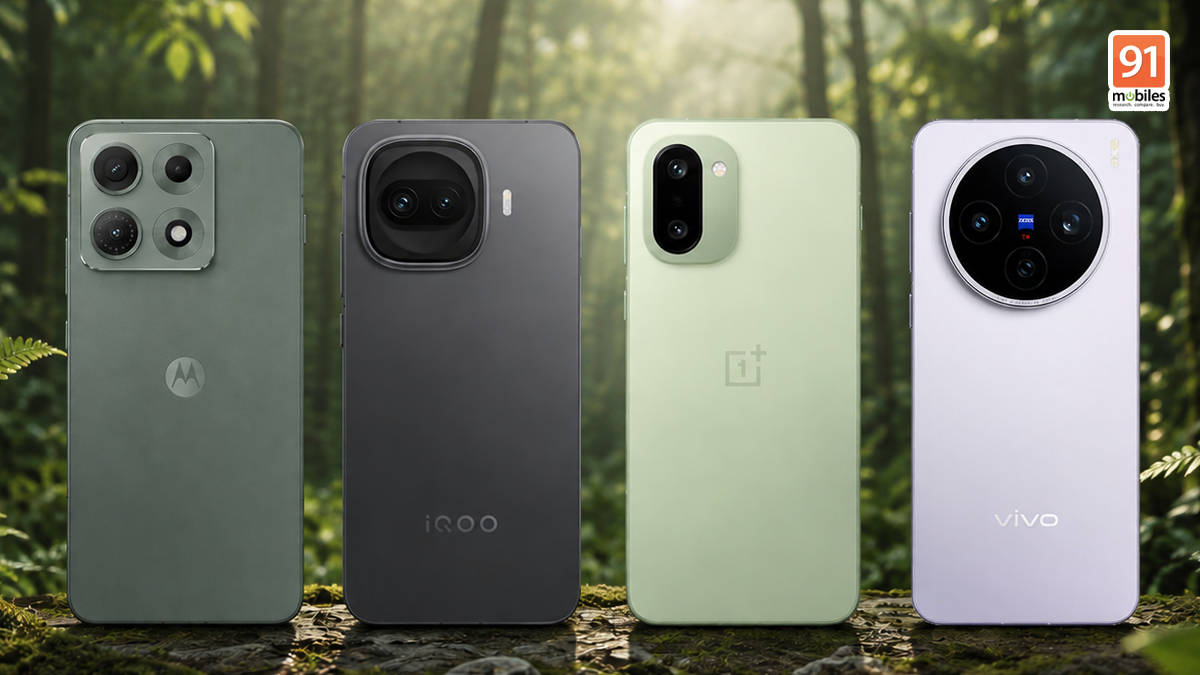
With the explosive growth of esports and the rising popularity of live streaming, smartphone brands have come up with serious gaming machines capable of handling high-frame-rate titles, competitive multiplayer matches, and hours of intensive play. While all-out flagships certainly rock bleeding-edge hardware for gaming, phones launched this year under Rs 60,000 prove that you don’t need to shell out a huge sum to enjoy reliable, high-performance gaming.
With several options out there, all packing powerful processors, advanced cooling systems, high-refresh-rate displays, and gaming-centric features, the decision to opt for one can be challenging. Therefore, in this guide, we’ve selected our top gaming phone picks in the sub-Rs 60,000 segment, in which the Motorola Edge 70 Max tops our list as the best overall gaming phone, the iQOO 15R for offering the best battery endurance, the Vivo X200T for packing a great balance of performance and cameras, and lastly, the OnePlus 15, which carries a feature-rich software with advanced gaming functionalities.
All the benchmark scores and testing data in this article are obtained from our in-house lab tests. Updated September 2026, you can read more about our testing methodology here.
Table of Contents
Winners at a glance
| Phone | Title | Current price |
| Motorola Edge 70 Max | Best overall gaming phone | Rs 54,999 (8+256GB) |
| iQOO 15R | Gaming phone with best battery | Rs 53,999 (8+256GB) |
| Vivo X200T | Gaming phone with best cameras | Rs 59,999 (12+256GB) |
| OnePlus 15R | Gaming phone with best software features | Rs 59,999 (12+256GB) |
Best overall gaming phone – Motorola Edge 70 Max
Why we chose it
The Motorola Edge 70 Max (review) is the latest offering in the market, powered by the Qualcomm Snapdragon 8 Gen 5, a chipset with excellent performance gains found on various sub-flagships, including many on this list. The chipset is paired with a 6.8-inch Quad HD+ (2K) LTPO AMOLED display with a 144Hz refresh rate and a 5,500mm² vapour chamber to keep temperatures under control during intensive gaming.


In our gaming tests, when playing Call of Duty: Mobile in the ‘Max’ graphics and ‘Max’ frame rate settings, the Edge 70 Max delivered average frame rates of 59.4, higher than the iQOO 15R by 1.4 frames, with the device’s temperature rising by only 3.8 degrees Celsius after 30 minutes of gameplay. On the other hand, running BGMI at ‘Ultra HDR’ graphics and ‘Ultra’ frame rates, the phone obtained an average frame rate of 38.5, with a similar temperature increase as CODM during a 30-minute gaming session.
Since the panel rocks a resolution of 1440 x 3168 (2K) pixels, it should offer the sharpest clarity among the phones listed here, even though the difference may be marginal. This not only enables high-detail gaming but also benefits YouTube viewing with native 2K (and 4K) playback. On top of this, the 7,100 mAh battery should easily last more than a day even with gaming, while Hello UI is free of third-party apps and bloatware for a clean software experience. With Qi 2.2 wireless charging on board, a feature not found on any of its rivals, it integrates magnets on the rear of the phone to not only support wireless charging at up to 25W but also allow users to attach compatible cooling accessories that help keep things cool during intensive gaming.
Key specifications and benchmarks
- Processor: Qualcomm Snapdragon 8 Gen 5
- Fabrication process: 3nm
- AnTuTu score: 29,72,932
- Geekbench score (single-core/multi-core): 2,823/ 8,890
- RAM: Up to 12GB
- RAM type: LPDDR5X
- Storage: Up to 256GB
- Storage type: UFS 4.1
Gaming phone with the best battery – iQOO 15R
Why we chose it
Featuring a massive 7,600mAh cell, the iQOO 15R (review) houses one of the biggest battery capacities on a high-end smartphone, with the OPPO Find X9 Pro trailing behind with 7,500mAh. Since hours of consecutive gaming sessions at high graphical settings demand long-lasting endurance, the iQOO 15R completely fulfils this need. The battery paired with the 3nm-based efficient Snapdragon 8 Gen 5 processor lasted 18 hours and 23 minutes in our PCMark Battery Drain test.
PCMark Battery score (in hours)


iQOO 15R
7600 mAh
18.4

OnePlus 15R
7400 mAh
18.2

Motorola Edge 70 Max
7100 mAh
16.6
PCMark battery test measures phone battery life from 100% to 20% (higher is better)
This particular test assesses the battery’s endurance by mimicking real-world tests, such as running and rendering videos, opening documents, browsing social media, etc. On to the games, playing CODM at the ‘Max’ graphics and ‘Max’ frame rate settings, the iQOO 15R dropped battery by just 4 percent after 30 minutes of gameplay, whereas the OnePlus 15R’s battery saw a decline of 7 percent in the same duration. Similarly, the iQOO 15R lost just 3 percent after playing BGMI for 30 minutes, while the OnePlus 15R’s battery went down by 6 percent, indicating efficient endurance on the iQOO smartphone.
Apart from that, the iQOO 15R took just 45 minutes to charge from 20 to 100 percent, allowing you to get back to gaming in no time when it’s low on charge. The strong endurance can also be attributed to the 6,500mm² IceCore vapour chamber, which seems to help keep things cool, resulting in less battery drain during heavy use.
Key specifications and benchmarks
- Processor: Qualcomm Snapdragon 8 Gen 5
- Fabrication process: 3nm
- AnTuTu score: 30,78,708
- Geekbench score (single-core/multi-core): 2,811/ 9,090
- RAM: Up to 12GB
- RAM type: LPDDR5X Ultra
- Storage: Up to 512GB
- Storage type: UFS 4.1
Gaming phone with the best cameras – Vivo X200T
Why we chose it
The Vivo X200T (review) gets the best of both worlds: a flagship-grade processor and the segment’s most versatile camera system. For starters, it’s equipped with the MediaTek Dimensity 9400+, which is matched up with a 4,500mm² vapour chamber for sustained gaming performance. The triple cameras at the rear comprise a 50MP primary camera, a 50MP ultrawide, and a 50MP periscope lens with 3x optical zoom, while the front camera gets a 32MP selfie unit.


When it comes to games, the Vivo X200T is an equally good performer as its close counterparts, such as the iQOO 15R and Motorola Edge 70 Max. When we ran CODM for 30 minutes, the X200T managed to deliver average frame rates of 58.2 in the ‘Max’ graphics and ‘Max’ frame rate settings, ever so slightly behind the said smartphones. However, it falls short in battery endurance due to its smaller 6,200mAh cell, and as a result, the X200T clocked 16 hours and 14 minutes in our PCMark Battery Drain test.
The Vivo X200T makes up for this by providing a superior camera experience, thanks to larger camera sensors, a dedicated periscope lens, and ZEISS tuning, which are not found on the iQOO 15R, OnePlus 15R, and Motorola Edge 70 Max. This makes the X200T a solid pick for photography enthusiasts willing to play high-end games for several minutes a day without worrying about stutter or low frame rates.
Key specifications and benchmarks
- Processor: MediaTek Dimensity 9400+
- Fabrication process: 3nm
- AnTuTu score: 28,21,319
- Geekbench score (single-core/multi-core): 2,675/ 8,463
- RAM: Up to 12GB
- RAM type: LPDDR5X Ultra
- Storage: Up to 512GB
- Storage type: UFS 4.1
Gaming phone with best software features – OnePlus 15R
Why we chose it
As noted in our long-term review of the OnePlus 15R, OxygenOS 16 is one of the most refined, fluid, and feature-rich Android skins out there. While it continues to offer immense homescreen and lockscreen customisability, nifty productivity and imaging AI features, and dozens of slick animations, it also offers a plethora of gaming features to take advantage of.

Sitting under “OP Gaming Core”, the OnePlus 15R includes features such as Ultra touch response for fast touch registration during crucial moments in games, Hyper frame rate to run certain games at up to 165FPS, such as Clash Royale and CODM, Voice Changer to not reveal your actual voice to random players in online games, such as BGMI, viewing real-time frame rate status through an overlay, which is not possible on all Android skins, among others.
On to the gaming performance, we were able to run CODM’s Multiplayer mode at 165FPS natively for several matches on the trot. During this session, as temperatures rose to 40-41 degrees Celsius, the frame rates didn’t drop below 160. Similarly, since Clash Royale is not as demanding as CODM, the OnePlus 15R delivered 165 FPS every single time without getting warm to the touch. Simply put, if you want a gaming-oriented smartphone with the goodness of feature-rich and fluid software, the OnePlus 15R is your best bet.
Key specifications and benchmarks
- Processor: Qualcomm Snapdragon 8 Gen 5
- Fabrication process: 3nm
- AnTuTu score: 29,57,229
- Geekbench score (single-core/multi-core): 2,851/ 9,363
- RAM: Up to 12GB
- RAM type: LPDDR5X Ultra
- Storage: Up to 512GB
- Storage type: UFS 4.1
Conclusion
Based on our rigorous testing and hands-on experience with all the high-end smartphones available under Rs 60,000, picking any device from this list will offer you a smooth and reliable experience. However, if you’re particular about certain features and have your preferred priorities, your choice can vary.
Therefore, for users on the hunt for a crisp and detailed display experience, solid battery backup, and consistent frame-rate gaming, the Motorola Edge 70 Max is our overall pick as the best gaming smartphone under Rs 60,000. If you prioritise the best possible battery life on a gaming-centric phone, the iQOO 15R is a solid choice, while the Vivo X200T not only packs a powerful processor but also delivers the best-in-class camera performance. However, its battery falls short of the competition.
Lastly, the OnePlus 15R is suitable for users prioritising the highest frame rates possible on a phone in India, while still delivering an expansive set of features for daily use and gaming.
FAQs
Do I really need to spend more than Rs 60,000 for a good gaming phone?
No, phones launched in 2026 under Rs 60,000 offer powerful processors, high-refresh-rate displays, efficient cooling, and strong battery life that deliver reliable high-frame-rate gaming performance for most titles.
Which phone can offer the best gaming performance while lasting for hours on a single charge?
The Motorola Edge 70 Max, equipped with the Qualcomm Snapdragon 8 Gen 5 and a 7,100mAh battery, ensures a top-notch gaming experience at high detail thanks to its 2K AMOLED panel, while lasting for hours on a single charge. Furthermore, when the battery does run out, it can be fully charged in just around an hour using its 90W charging adapter.
Which phone is best for the highest frame rates?
The OnePlus 15R is ideal for users who prioritise the highest possible frame rates while still offering a well-rounded set of features for everyday use and gaming. It comes with 165Hz refresh rate support, but it’s limited to only a few games, including popular ones such as Call of Duty: Mobile, Clash Royale, Clash of Clans, BGMI (with frame interpolation), and a few others.
Which phone has the best camera performance in the Rs 60,000 price range?
The Vivo X200T delivers the best-in-class camera setup while still packing a powerful processor suitable for gaming.
What key features should I look for in a gaming phone under Rs 60,000?
Focus on a capable chipset, high refresh-rate display (120Hz or higher), effective cooling, good sustained performance, solid battery capacity with fast charging, and optimised gaming software.