Nothing Phone (4a) long-term review: four months and a few price hikes later…


It’s been over four months since the Nothing Phone (4a) made its global debut at Rs 31,999. Amid the worsening memory chip crisis in the tech industry, the phone has received several price hikes and now sits at Rs 39,999. Given this steep increase, does the Phone (4a) still make sense compared to the competition, especially with the more affordably priced Phone (4b) at Rs 34,999? Also, how have the software updates fared since our original review? Find out in this long-term review.
Table of Contents
Design still stands out
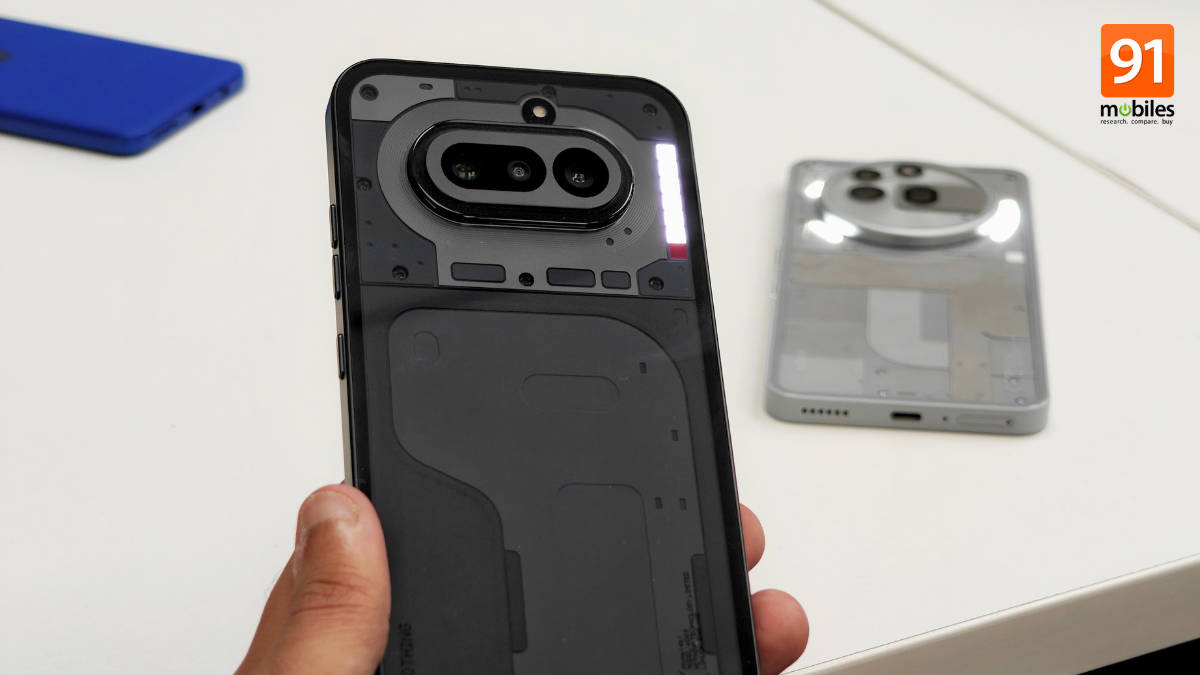
Even after four months of its launch, the Nothing Phone (4a) continues to distinguish itself with its signature ‘Nothing aesthetics’. Featuring multiple intricate elements, such as an oval coil, plates, screws, and, of course, the Glyph Bar under a transparent rear panel, the Phone (4a) maintains its identity in a world of phones with bland and minimalist designs. While such designs may not favour everyone, it certainly gives the device an identity of its own, worthy of making a statement.


Our Black colour variant of the Nothing Phone (4a) sports an understated look, but the White and Pink versions make the phone stand out even more. Coming to ergonomics, the Phone (4a)’s boxy build weighs 204.5g and measures 8.6mm, making it a tad heavier and thicker than newer releases under Rs 40,000, such as the Moto Edge 70 Pro (review) and Redmi Turbo 5 (review). Furthermore, both the said smartphones carry at least an IP68 rating, while the Phone (4a) is limited to IP64, meaning it can be exposed to water only for short durations.
| Smartphone | Thickness | Weight | IP Rating |
| Nothing Phone 4a 8GB RAM | 8.5 mm | 205 grams | IP64 |
| Motorola Edge 70 Pro 5G | 6.99 mm | 183 grams | IP68 +IP69 |
| Xiaomi Redmi Turbo 5 | 8.18 mm | 204 grams | IP68 +IP66 +IP69K +IP69 |
In practical use, it won’t take long to get used to the Phone (4a)’s boxy build; however, if you’re seeking something more comfortable, the Moto Edge 70 Pro’s subtly curved display and back panel is likely to sit in more comfortably in your hands, while the Redmi Turbo 5’s shorter height makes it ideal for people who wish to wield compact phones.
Is the Glyph Bar better than the Glyph Interface?
Compared to the Nothing Phone (3a), the biggest design and functionality change on the Phone (4a) is ditching the circular Glyph Interface in favour of the Glyph Bar, a strip comprising six square LED lights. Just like the previous LED implementations, the strip lights up when receiving notifications or calls, adjusting the volume, running a timer, or showing the status of a delivery or order.


That said, I frequently used the Glyph Bar’s Essential Notifications feature to check for WhatsApp messages when the phone was face down. Similarly, enabling the ‘Volume indicator’ feature lets you view the volume level by how many LEDs are lit when you press either volume button.
Sharp and bright display
The 6.78-inch 1.5K AMOLED display of the Nothing Phone (4a) continues to offer an excellent display experience. As stated in our initial review, the display outputs punchy and vibrant tones by default in the ‘Alive’ profile, while the 1,600 nits outdoor brightness ensures easy legibility outdoors under direct sunlight. The 120Hz refresh rate is open to all apps and interfaces, providing a seamless and smooth scrolling experience.

Coming to the speakers, the Phone (4a) features a stereo setup that delivers reasonably loud sound. While there is slight muddiness at maximum volume, it doesn’t significantly affect the overall listening experience.
Software experience gets better over time
The Nothing Phone (4a) and Phone (4a) Pro were the first smartphones to debut with Nothing OS 4.1, bringing some much-needed additions, such as the depth wallpaper effect on the lockscreen, AI Eraser in the Gallery app, Android 16’s Live Update integration for Google Maps, and much more.
While we’ve already covered the above-mentioned aspects in detail in our Nothing OS 4/4.1 update guide and CMF Phone 2 Pro long-term review, I’d like to point out that Nothing has frequently rolled out updates to the Phone (4a) since its release, resulting in improved stability and feature set over time. At the time of drafting this long-term review, the Phone (4a) was running on the May 2026 security patch, which may not be the latest, but the next update shouldn’t take long to arrive given the track record.
In terms of software experience, the Phone (4a) is extremely smooth to use. Despite a not-so-high-end processor, it has been tuned well to deliver a fluid experience. Pair that with 120Hz refresh rates, and I didn’t notice any lags or jitters during my use. The phone will receive three OS upgrades, which is quite standard for a device priced under Rs 40,000.
Telephoto lens still makes it a solid camera phone
The cameras of the Nothing Phone (4a) clearly remain the highlight of the device, especially in a segment where telephoto lenses have become non-existent. To recall, the handset sports a 50MP 1/1.57-inch Samsung GN9 primary camera with OIS, a 50MP 1/2.75-inch JN5 telephoto lens with 3.5x optical zoom, an 8MP Sony IMX355 ultrawide lens with a 120-degree FoV, and a 32MP selfie camera.

As stated in our original review, the main camera continues to output tones that are true to the scene, without adding extra vibrancy, at least outdoors. While this holds for indoor scenarios as well, the shots may often carry grain when you zoom into the image. Similarly, while low light results are well-exposed with balanced colour tones, the dark or shadow areas may at times contain grain, especially in telephoto and ultrawide shots.
Coming to the star of the show, the telephoto lens, which captures images at 80mm focal length, is a noteworthy addition that turns the tide in favour of the Phone (4a) for being the only phone under Rs 40,000 this year to be equipped with this lens. Just like the primary camera, it outputs true-to-life colours and prominently separates the subject from the background, resulting in a natural-looking bokeh effect.
Reliable performance even after four months
Now that the Phone (4a)’s price has been raised significantly, the Qualcomm Snapdragon 7s Gen 4 powering the device is one of its least impressive aspects, at least on paper, given that phones like the Redmi Turbo 5 and Moto Edge 70 Pro rock the much superior MediaTek Dimensity 8500 chipset.

AnTuTu score


Motorola Edge 70 Pro 5G
MediaTek Dimensity 8500 Extreme
2,194,258

Xiaomi Redmi Turbo 5
MediaTek Dimensity 8500 Ultra
2,135,669

Nothing Phone 4a 8GB RAM
Qualcomm Snapdragon 7s Gen 4
1,176,492
AnTuTu assesses a smartphone's CPU, GPU, memory, and overall user experience (higher is better)
Geekbench multi-core score
Motorola Edge 70 Pro 5G
MediaTek Dimensity 8500 Extreme
6,864
Xiaomi Redmi Turbo 5
MediaTek Dimensity 8500 Ultra
6,657
Nothing Phone 4a 8GB RAM
Qualcomm Snapdragon 7s Gen 4
3,364
Geekbench assesses the efficiency of the CPU's single and multiple cores (higher is better)
But does that stop the Phone (4a) from delivering a reliable everyday experience? Absolutely not, as users with casual and professional workflows will find the phone’s performance more than sufficient for everyday tasks. In my case, I used the Phone (4a) for doomscrolling Instagram, reading articles, clicking pictures, chatting, and checking emails; it handled it all without any fuss.
For users prioritising mobile gaming, you’re better off with the likes of the Redmi Turbo 5, OPPO K13 Turbo, and even the Motorola Edge 70 Pro for gaining sustained performance, especially at 120 FPS on popular titles like BGMI and CODM.
Battery life could have been better
Just like the performance, the battery is another department where the Nothing Phone (4a) isn’t chasing big numbers. The nominal-sized 5,400mAh cell offered a runtime of 14 hours and 42 minutes in our PCMark Battery drain test from 100 to 20 percent when we tested it during launch.
While these are impressive numbers, it’s no match for phones priced lower or on par with the Phone (4a), such as the OnePlus Nord CE 6 and Redmi Turbo 5, as you can see in the chart below.
PCMark Battery score (in hours)

OnePlus Nord CE 6 5G
8000 mAh
18.6
Xiaomi Redmi Turbo 5
7540 mAh
16.1
Nothing Phone 4a 8GB RAM
5400 mAh
14.7
PCMark battery test measures phone battery life from 100% to 20% (higher is better)
In real-world use, the Phone (4a) comfortably offered me screen on time of anywhere between six and nine hours on a full charge. As noted in the performance section, my usage involved watching YouTube videos, streaming shows on Prime Video, using Instagram, reading articles, clicking pictures, chatting, and checking emails.
While this level of battery backup is impressive for a phone with a 5,400mAh battery, devices featuring cells over 6,500mAh are sure to deliver even better endurance under similar usage.
Is Nothing Phone (4a) still worth buying?
Despite not leading the charts in key aspects, such as performance, battery, and ingress protection, the Nothing Phone (4a) has a lot going for it in terms of software, design, and cameras, the core key differentiators of Nothing smartphones.

As for what’s the right choice between the Phone (4a) and Phone (4b), which is priced at Rs 34,99, by paying an extra Rs 5,000, you achieve a far superior camera setup, a premium build with a glass back, and faster performance on the (4a). Overall, the Phone (4a) still makes sense for those who value minimalist software, reliable day-to-day performance, and strong, versatile cameras.