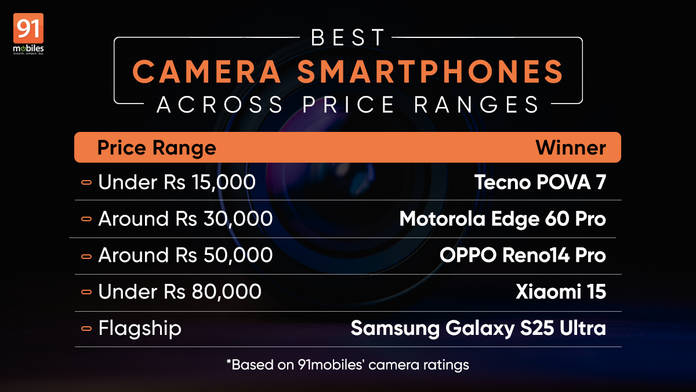
Choosing a new smartphone today is, in many ways, choosing a new camera. For most of us, it’s the primary device we use to capture everything from everyday moments to once-in-a-lifetime trips. But with every brand claiming to have the best camera technology, distinguishing between marketing hype and real-world performance can pose a challenge. That’s where we come in. We’ve spent countless hours testing the latest smartphones to see how their cameras perform in the real world. This guide highlights the best camera phones in their particular price bracket. Whether you’re a casual point-and-shooter or a budding enthusiast, we’ll help you find the perfect camera phone for your needs and budget.
Selection criteria
Our recommendations are built on extensive, hands-on testing. We don’t just look at spec sheets; we take these phones out and shoot with them, comparing each one directly against its closest rivals in a variety of situations.
Our evaluation focuses on what really matters in a photo:
- Colour and detail: How accurately are colours reproduced? Are the photos sharp and full of detail, or do they look soft and muddy?
- Portraits and selfies: We look closely at how well the camera handles skin tones and captures fine details like hair. We also check how cleanly it separates the subject from the background.
- Low Light: This is the ultimate test for any camera. We pay special attention to how well a phone performs in dimly lit environments, looking at its ability to control stray light, manage noise, and maintain clarity.
To make our rankings as objective as possible, our review team follows a careful scoring process. For every key scenario like daylight, ultra-wide, portrait, selfie, and low light, each phone is rated on multiple factors. These individual ratings are then averaged to create a final, comprehensive score that gives a clear picture of each phone’s true imaging capabilities based on our parameters.
Table of Contents
Best camera phones under Rs 15,000
Winner: Tecno POVA 7
Rear camera: 50MP
Front camera: 13MP
| Best camera phones under Rs 15,000 | 91mobiles camera rating |
| Tecno POVA 7 | 8.5 |
| OPPO K13x | 8.4 |
| Infinix Note 50x | 8.3 |
The Tecno POVA 7 (review) emerged as the top camera phone under this price segment. It features a single 50MP rear camera and a 13MP front camera, both of which can record impressive 4K video, a step up from competitors. In good lighting, it captures sharp, detailed photos with balanced exposure, though colours can sometimes appear unnatural with a yellowish tint. The phone does really well with its portrait photos with clear subjects, accurate skin tones, and a clean background blur. Selfies are detailed but often have a warmer look. In low light, it performs decently by controlling brightness and noise, but its dedicated night mode isn’t as clean or detailed as some other rivals.
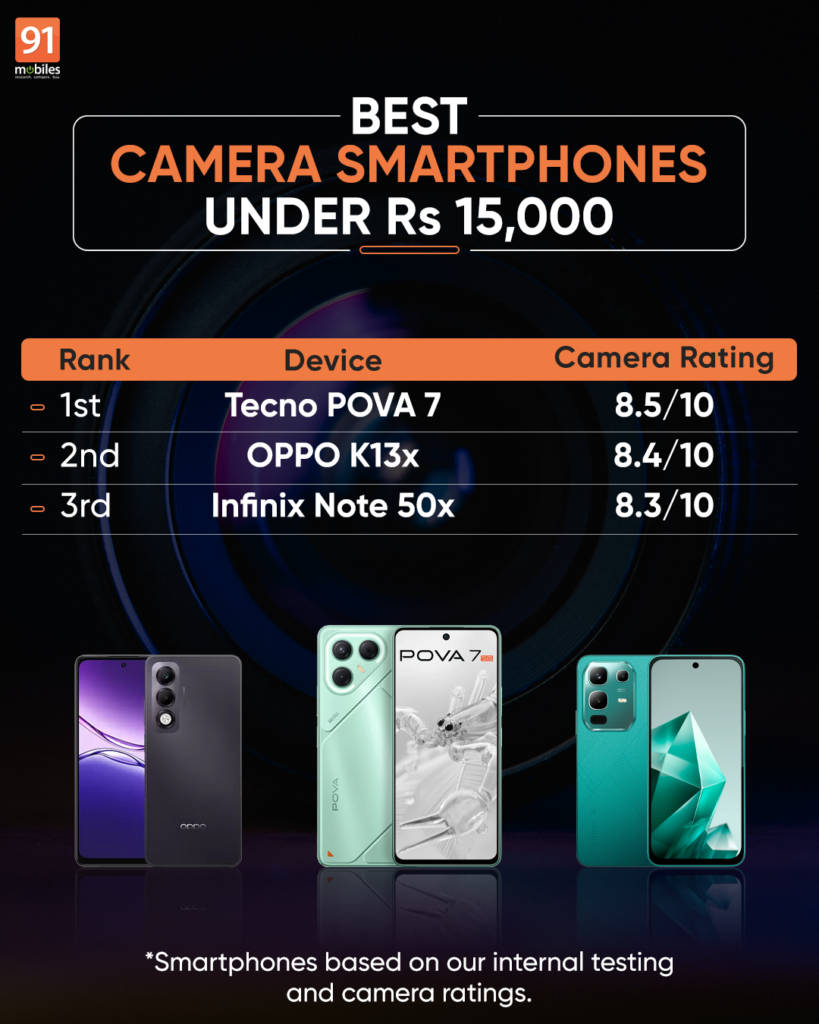
Runners-up: The OPPO K13x (review) and Infinix Note 50x (review) are both capable runners-up, but they have their own individual strengths. The OPPO K13x is the choice for those who prefer natural, realistic colours, especially in daylight and selfies. However, its photos can sometimes lack sharp detail and look a bit flat. In contrast, the Infinix Note 50x is a reliable all-around performer. It consistently captures sharp, detailed photos with pleasant colours and performs better in both portrait mode and low-light conditions, where it effectively controls noise and maintains accuracy.


Tecno POVA 7 camera highlights:
| Pros | Cons |
| Sharp, detailed daylight shots with good light control | Colours can look unnatural with a yellowish tint |
| Excellent portraits with close-to-accurate skin tones | Night mode photos lack detail compared to rivals |
| Records 4K video from front and back cameras | Does not have a depth camera |
Best camera phones around Rs 30,000
Winner: Motorola Edge 60 Pro
Rear camera: 50MP primary + 50MP wide-angle + 10MP telephoto
Front camera: 50MP selfie
| Best camera phones around Rs 30,000 | 91mobiles camera rating |
| Motorola Edge 60 Pro | 8.5 |
| Realme 15 Pro | 8.4 |
| Nothing Phone (3a) Pro | 8.3 |
The Motorola Edge 60 Pro (review) is a good all-rounder with a very versatile camera setup. It works great for taking crisp, punchy photos in daylight. But what really makes it special is the high-resolution ultra-wide camera, which captures incredibly detailed wide shots, and its telephoto lens, which takes fantastic portrait photos with a great balance of sharpness and natural looks. The phone also does a good job in low light, producing clean images with good colour. While the selfies are appealing, they can sometimes look a little over-sharpened. It’s a very reliable choice for almost any situation.
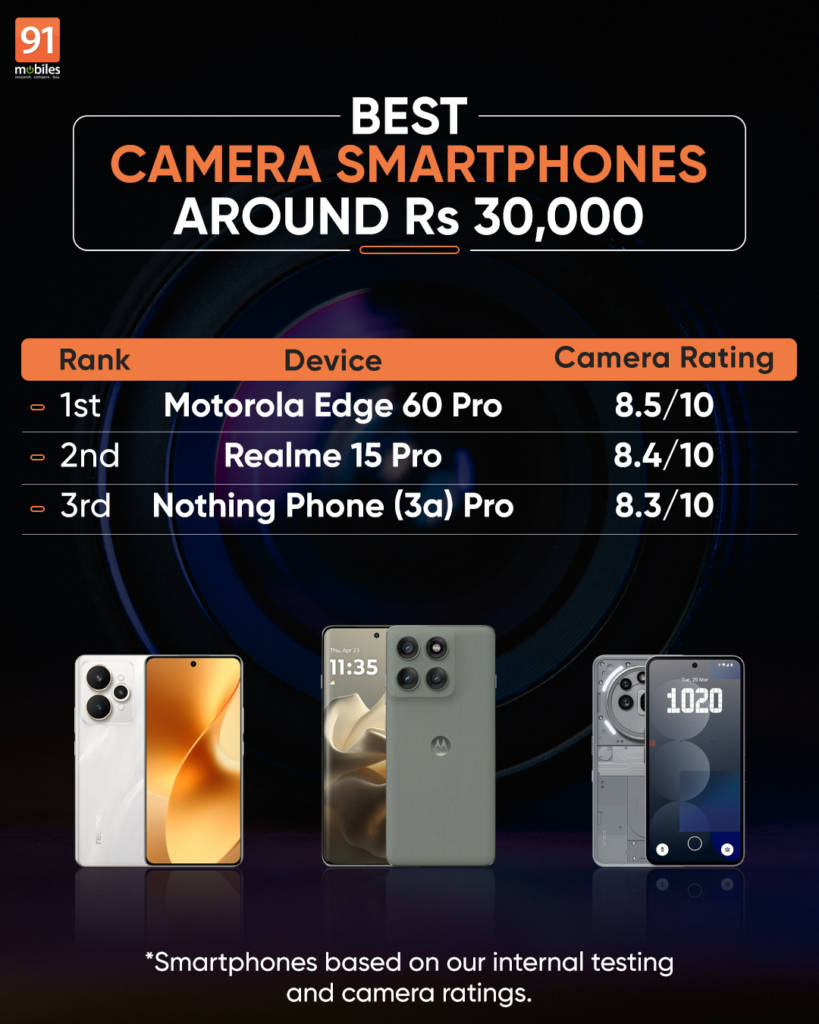
Runners-up: The Realme 15 Pro (review) and Nothing Phone (3a) Pro (review) are both strong contenders, each with unique strengths. The Realme 15 Pro really lives up to its “AI Party Phone” name; it is fantastic for night shots, producing clean, detailed images with some handy AI camera features. However, its portrait photos can look a bit soft. On the other hand, the Nothing Phone (3a) Pro is a great choice for daytime photography. It captures vibrant photos and takes some selfies with natural skin tones and lots of detail. Its main drawback is the zoom lens, which makes its portraits less impressive than its rivals.


Motorola Edge 60 Pro camera highlights:
| Pros | Cons |
| High-resolution ultra-wide camera is very sharp | Selfies can sometimes look over-sharpened |
| Great portraits with refined detail and balance | Colour shifts when changing lenses |
| Impressive low-light performance | Video stabilisation is not the best |
Best camera phones around Rs 50,000
Winner: OPPO Reno14 Pro
Rear camera: 50MP primary + 50MP wide-angle + 50MP telephoto
Front camera: 50MP selfie
| Best camera phones around Rs 50,000 | 91mobiles camera rating |
| OPPO Reno14 Pro | 8.5 |
| Vivo X200 FE | 8.4 |
| OnePlus 13s | 8.3 |
The OPPO Reno14 Pro (review) comes with a really versatile camera setup, including a dedicated telephoto lens for zoom. It is fantastic for taking sharp, detailed pictures in almost any situation. The ultrawide camera is especially good, and the telephoto lens takes crisp portraits with a nice background blur. Its main weakness is colour; photos often look punchy and vibrant, but skin tones can sometimes appear unnatural. At night, it captures amazing detail but can struggle to handle bright lights. It’s a good choice if you prioritise sharpness and detail in your photos.
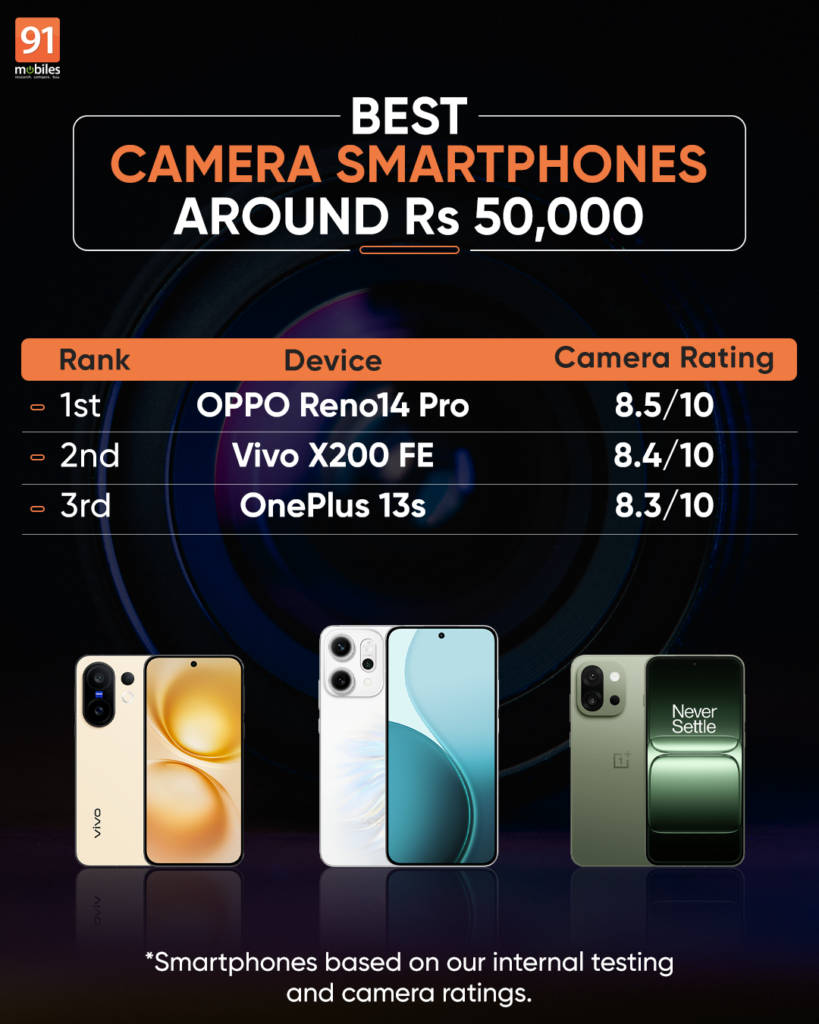
Runners-up: The Vivo X200 FE (review) and OnePlus 13s (review) both take great photos but offer very different experiences. The Vivo X200 FE is the more versatile option, with a fantastic main camera and a powerful telephoto lens that excels at creating vibrant, eye-catching portraits. Its only real weakness is a lacklustre ultra-wide camera. The OnePlus 13s, on the other hand, focuses on doing one thing very well. Its main camera is excellent for capturing sharp, impressive daylight shots. However, it completely lacks an ultra-wide lens and has a limited portrait mode, making it feel less flexible than its rivals.


OPPO Reno14 Pro camera highlights:
| Pros | Cons |
| Captures very sharp and detailed photos | Colours can be oversaturated |
| Excellent ultra-wide camera quality | Struggles with bright lights in night shots |
| Telephoto lens delivers crisp portraits | Skin tones can look unnatural at times |
Best camera phones under Rs 80,000
Winner: Xiaomi 15
Rear camera: 50MP primary + 50MP wide-angle + 50MP telephoto
Front camera: 50MP selfie
| Best camera phones under Rs 80,000 | 91mobiles camera rating |
| Xiaomi 15 | 8.5 |
| Vivo X200 | 8.4 |
| iPhone 16 | 8.3 |
The Xiaomi 15 (review) is a powerhouse with its camera system, using three 50MP lenses that give you a lot of flexibility for different kinds of shots. It takes sharp, colourful photos in daylight and produces really bright, eye-catching portraits. Selfies are also a strong point. The main thing to watch out for is consistency; it can be a bit hit-or-miss with exposure, so you might need to snap a few pictures to get the perfect one. It also needs a little help in the dark, as its regular low-light shots are just okay, but it gets much better when you manually switch on the night mode.
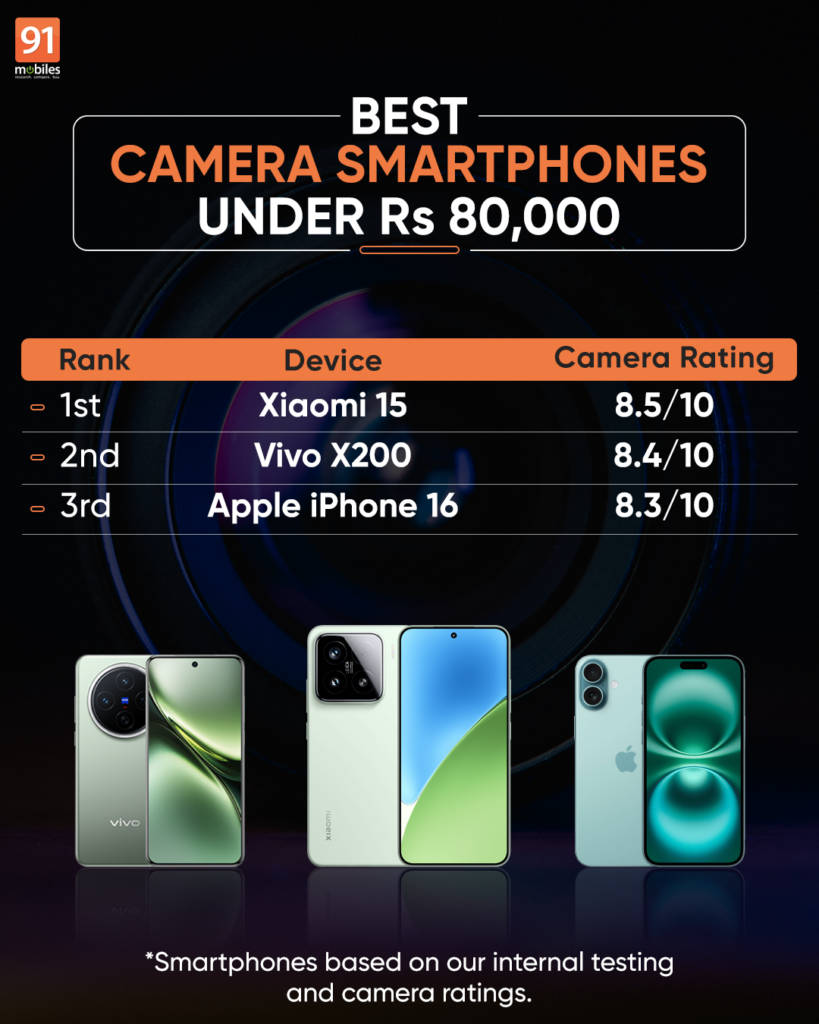
Runners-up: The Vivo X200 (review) and iPhone 16 (review) are both excellent camera phones in their own right, but they cater to different kinds of photographers. The Vivo X200 is for those who love vibrant, eye-catching photos that are ready to share right away. It’s a true portrait powerhouse, consistently delivering beautiful shots with great detail and creative options, making it incredibly reliable. The iPhone 16, on the other hand, is all about natural realism and creative control. It captures sharp, clean photos and much-improved portraits with accurate skin tones. Its main advantage is the new Photographic Styles feature, which lets you deeply customise the look of your images. The iPhone 16 also offers one of the best video capabilities in its price bracket.




Xiaomi 15 camera highlights:
| Pros | Cons |
| Sharp, colourful photos in daylight | Inconsistent exposure |
| Versatile system with 50MP lenses | Can be slow to lock focus |
| Night mode significantly improves low-light shots | Default low-light performance is weak |
Best camera flagships
Winner: Samsung Galaxy S25 Ultra
Rear camera: 200MP primary + 50MP wide-angle + 50MP telephoto + 10MP telephoto
Front camera: 12MP selfie
| Best camera phones under Rs 80,000 | 91mobiles camera rating |
| Samsung Galaxy S25 Ultra | 8.6 |
| Xiaomi 15 Ultra | 8.5 |
| Vivo X200 Pro/OPPO Find X8 Pro | 8.4 |
The Samsung Galaxy S25 Ultra (review) is a true flagship camera and a fantastic all-around performer. Its biggest upgrade is the new 50MP ultra-wide camera, which now captures incredibly sharp and detailed shots. The phone excels at capturing accurate skin tones, making its portrait photos look very natural. It’s also a great low-light performer and does a good job of balancing bright areas without blowing them out. While it can sometimes make photos look a bit too warm, and its selfies aren’t as detailed as some rivals, it’s a versatile and reliable camera setup for almost any situation.

Runners-up: The Xiaomi 15 Ultra’s (review) camera system is defined by its dramatic Leica image processing. Its key highlight is the new 200MP telephoto lens, which captures detailed portraits with impressive edge detection. Photos across the board are sharp and heavily boosted for a warm, high-contrast look that is ready for social media. While it performs very well in low light, it can occasionally struggle to lock focus, and its selfies tend to smooth out the facial features. It’s an excellent choice for users who prefer a stylised, punchy aesthetic straight from the camera.
The third spot is tied between the Vivo X200 Pro (review) and the OPPO Find X8 Pro (review). Both are incredible camera phones, but they offer distinct styles. The Vivo X200 Pro is the undisputed king of low-light photography, capturing stunningly clear images in the dark. It also excels at creating beautiful, natural-looking portraits and offers creative flexibility with features like a tele-macro lens. The OPPO Find X8 Pro is all about a dramatic, high-impact look, thanks to its Hasselblad tuning. Its dual telephoto lenses are phenomenal for sharp zoom shots and striking portraits, consistently producing warm, high-contrast images that are perfect for social media.








Samsung Galaxy S25 Ultra camera highlights:
| Pros | Cons |
| New ultra-wide camera captures excellent detail | Sometimes adds an unnatural warm tint to images |
| Captures very accurate and natural skin tones | Selfies lack facial details |
| Great low-light performance with balanced exposure | No major upgrades from last year |