As 2025 comes to a close, it is finally time to lock in the smartphone camera rankings for the year before a fresh wave of launches resets the playing field. The flagship space has mostly settled for now, even though a few important releases like the next Galaxy S series and Xiaomi’s number series are still on the horizon.
This has also been the year where almost every phone, from budget to premium, arrived with its own set of AI camera features to clean up noise, tweak colours, and refine images, while telephoto cameras became a major trend across mid-range and flagship devices. This article breaks down the best camera phones of 2025 based on internal testing and explains which ones are worth your money if you want stellar camera performance.
Selection criteria
Our recommendations are built on extensive, hands-on testing. We don’t just look at spec sheets; we take these phones out and shoot with them, comparing each one directly against its closest rivals in a variety of situations.
Our evaluation focuses on different aspects that we consider make a good image:
- Colour and detail: How accurately are colours reproduced? Are the photos sharp and full of detail, or do they look soft and muddy?
- Portraits and selfies: We look closely at how well the camera handles skin tones and captures fine details like hair and facial texture. We also check how cleanly it separates the subject from the background.
- Low Light: This is the ultimate test for any camera phone. We pay special attention to how well a phone performs in dimly lit environments, looking at its ability to control stray light and lens flares, manage noise, and maintain clarity.
To make our rankings as objective as possible, our review team follows a careful scoring process. For every key scenario like daylight, ultra-wide, portrait, selfie, and low light, each phone is rated on multiple factors. These individual ratings are then averaged to create a final, comprehensive score that gives a clear picture of each phone’s true imaging capabilities based on our parameters.
Table of Contents
Best camera phones under Rs 15,000
Winner: Tecno POVA 7 and Realme P4x
| Best Camera Phones | 91mobiles Camera Rating |
| Realme P4x/Tecno POVA 7 | 8.6/10 |
| OPPO K13x | 8.5/10 |
| Samsung Galaxy A17 | 8.4/10 |
The Tecno POVA 7 (review) is the one to pick if you care about sharp, detailed shots with steady exposure in most conditions, with sharp daylight photos, pleasing portraits, and detailed selfies, though its night mode is not as clean or colour-accurate as some rivals.
The Realme P4x (review) goes for sharp, high‑contrast images that look close to real life, delivering very detailed daylight shots, realistic selfies, and realistic low‑light photos. Although its portraits can look a touch oversharpened, and some noise creeps in at night.
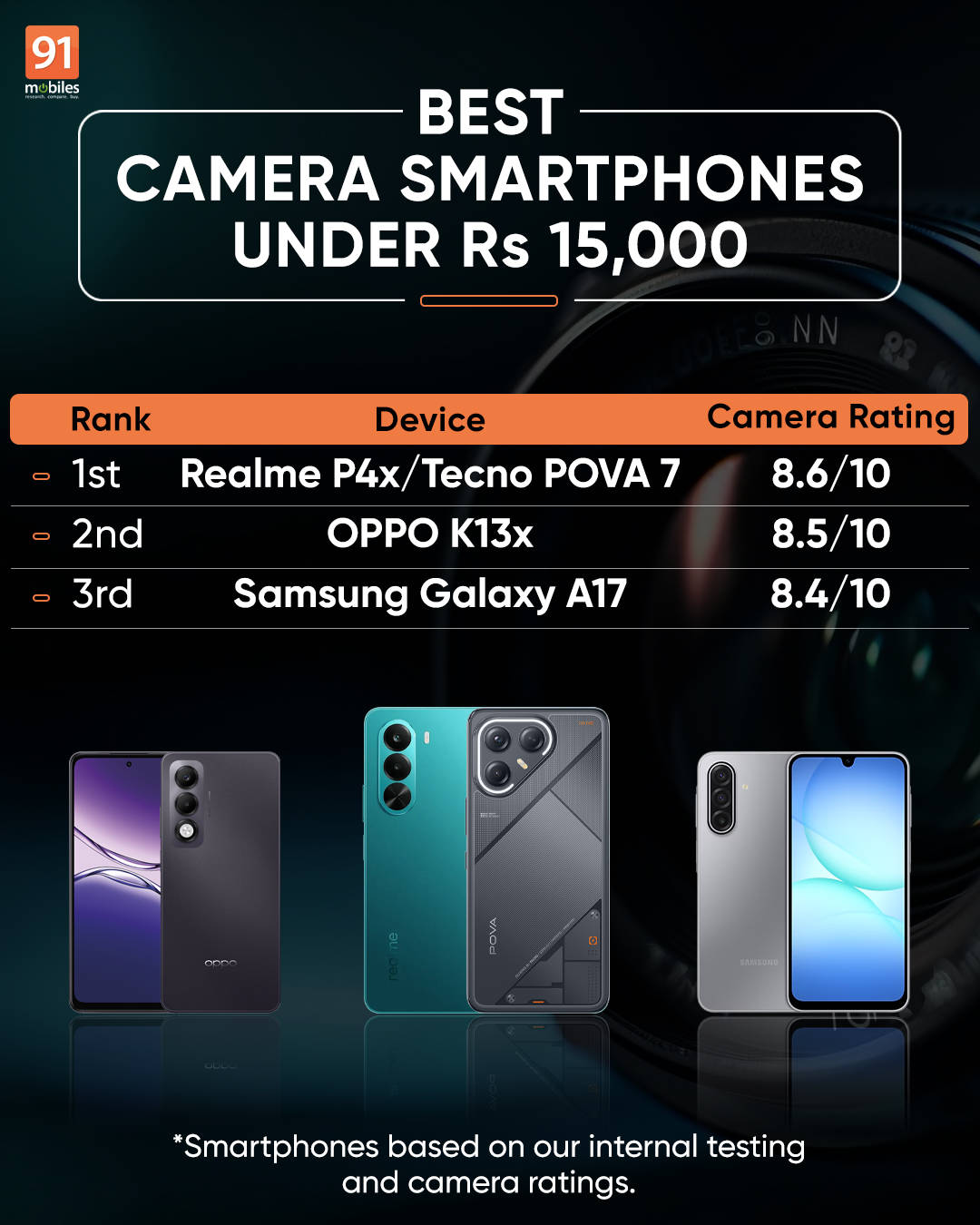
Runners‑up: The OPPO K13x (review) suits those who prefer natural, realistic colours in daylight and selfies, but its photos can lack fine detail and look a bit flat. The Galaxy A17 (review) offers a balanced experience with especially good low‑light performance, even if its daylight shots and selfies are only decent in terms of detail.
Best camera phones under Rs 30,000
Winner: Motorola Edge 60 Pro
| Best Camera Phones | 91mobiles Camera Rating |
| Motorola Edge 60 Pro | 8.5/10 |
| Realme 15 Pro | 8.4/10 |
| Nothing Phone (3a) Pro/Vivo V60e | 8.4/10 |
The Motorola Edge 60 Pro (review) is a great all‑rounder, with sharp, punchy daylight photos, a high‑resolution ultra‑wide camera for detailed wide shots, and a telephoto lens that delivers excellent portraits with natural background blur, plus decent low‑light results, though the selfie camera can oversharpen at times.
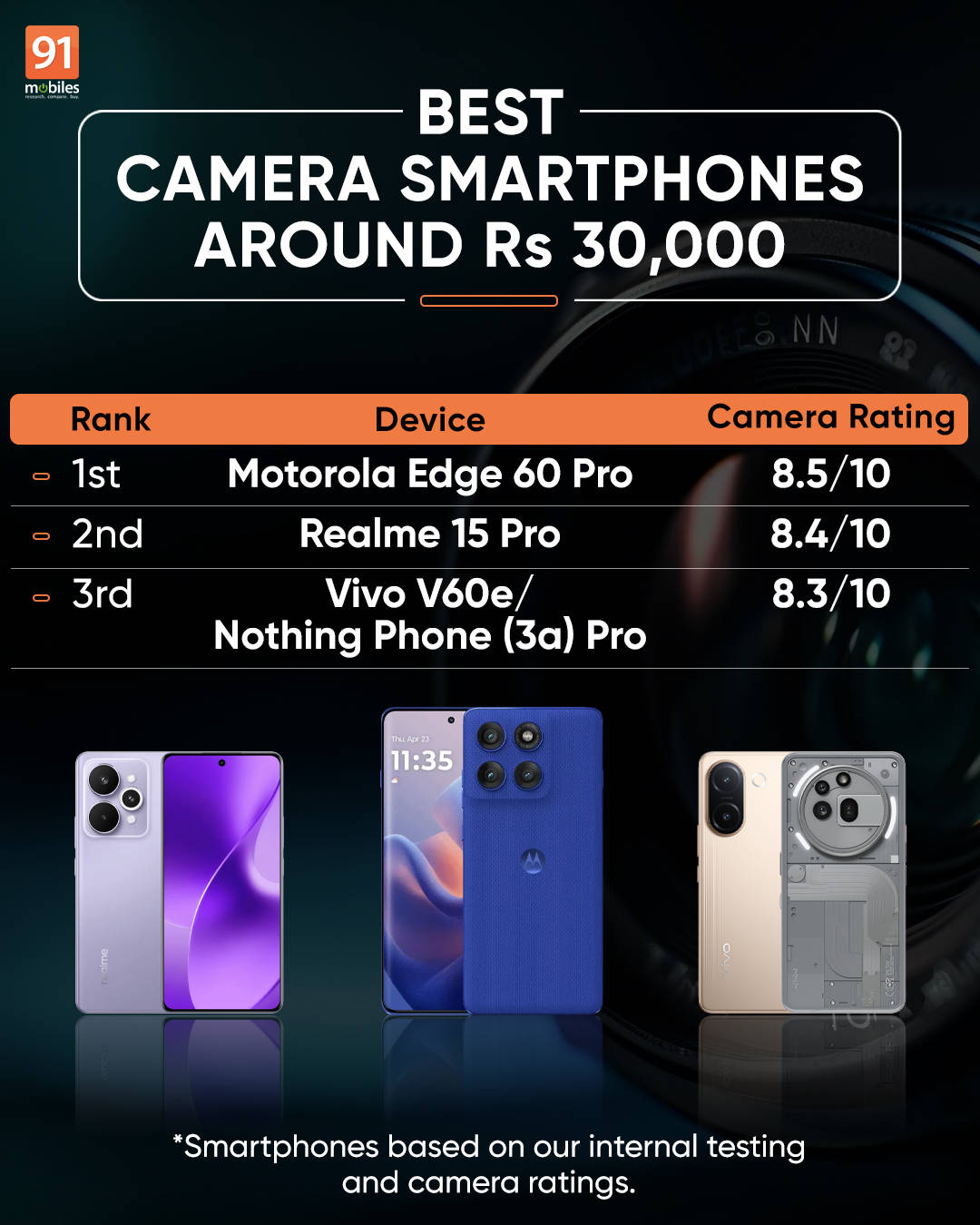
Runners up: The Realme 15 Pro (review) takes second place with strong night photography and useful AI features, even if its portraits sometimes look a bit too soft. At third, there is a tie between the Nothing Phone (3a) Pro (review), which works well in daylight with punchy, detailed shots and natural‑looking selfies but weaker zoom and portraits.
The Vivo V60e (review) also offers good daylight and surprisingly detailed low‑light shots, although colours can be oversaturated and portrait mode suffers from inconsistent edge detection and blur.
Best camera phones around Rs 50,000
Winner: OPPO Reno14 Pro
| Best Camera Phones | 91mobiles Camera Rating |
| OPPO Reno14 Pro | 8.5/10 |
| Vivo X200 FE/Pixel 9a | 8.4/10 |
| OnePlus 13s | 8.3/10 |
The OPPO Reno14 Pro (review) brings a versatile setup with an excellent ultrawide and a dedicated telephoto for crisp portraits, delivering sharp, detailed photos overall, but its colour accuracy is hit‑and‑miss, with sometimes unnatural skin tones and some struggle with bright lights at night.
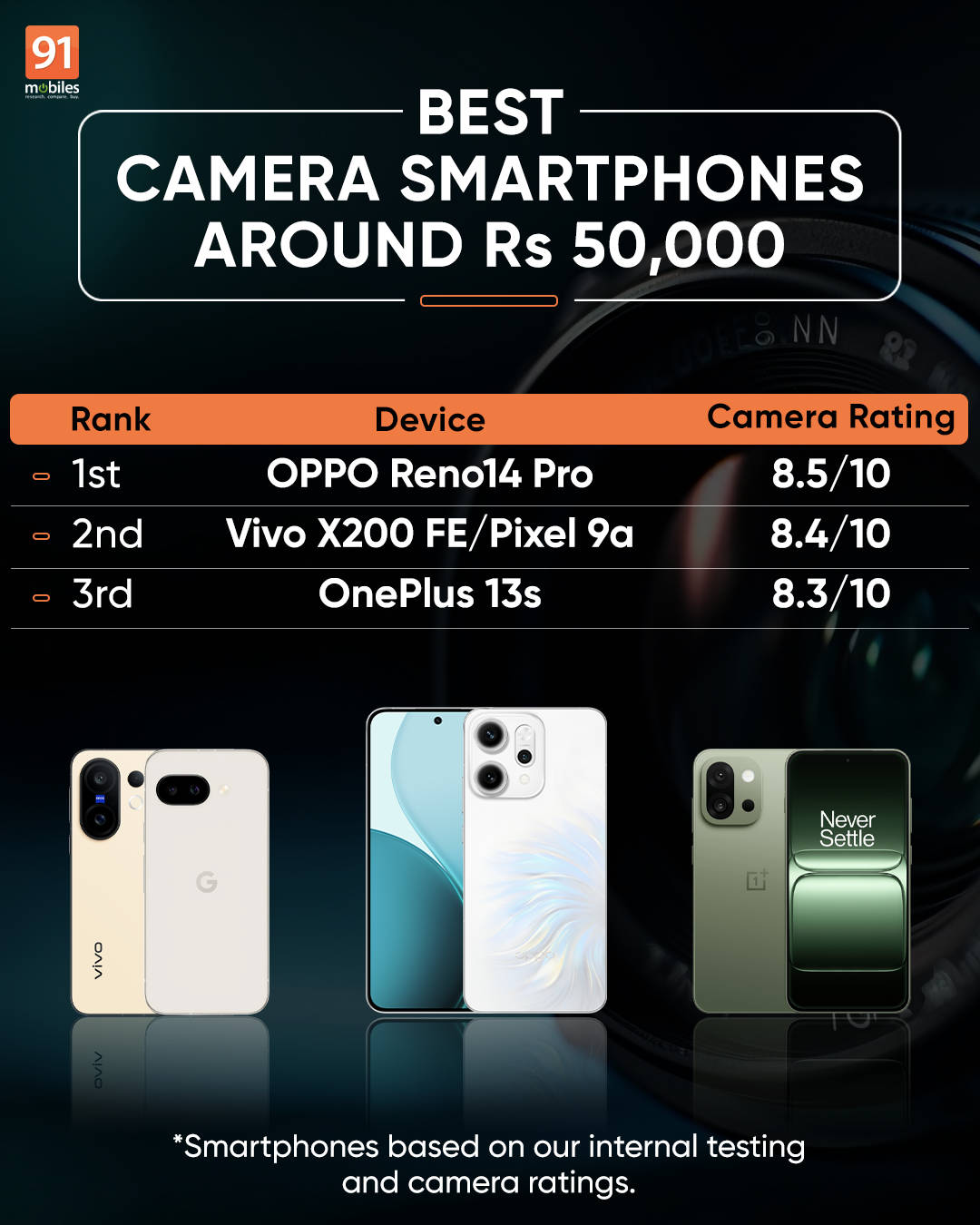
Runners-up: In a tied second spot, the Vivo X200 FE (review) combines a strong main camera with a capable telephoto for punchy, detailed portraits, though the ultra‑wide is clearly weaker, while the Pixel 9a (review) proves a single main camera can still deliver sharp, well‑exposed shots and pleasing portraits and selfies in good light but falls behind rivals in low light.
In third place, the OnePlus 13s (review) focuses on one thing, offering an excellent main camera for sharp daylight shots, yet it skips an ultra‑wide lens and has a limited portrait mode, which makes it less flexible overall.
Best camera phones under Rs 80,000
Winner: Vivo X300
| Best Camera Phones | 91mobiles Camera Rating |
| Vivo X300 | 8.6/10 |
| iPhone 17 | 8.5/10 |
| OPPO Find X9/iQOO 15 | 8.4/10 |
The Vivo X300 (review) is a standout choice for photography, delivering sharp, punchy daylight shots with good contrast and plenty of detail. Portraits look impressive too, with vibrant tones and well‑defined subjects, even if skin can appear slightly bright at times. Selfies are another strong point in both daylight and low light, offering natural skin tones and solid detail, though the ultrawide camera and overall low‑light performance can still be a bit inconsistent.
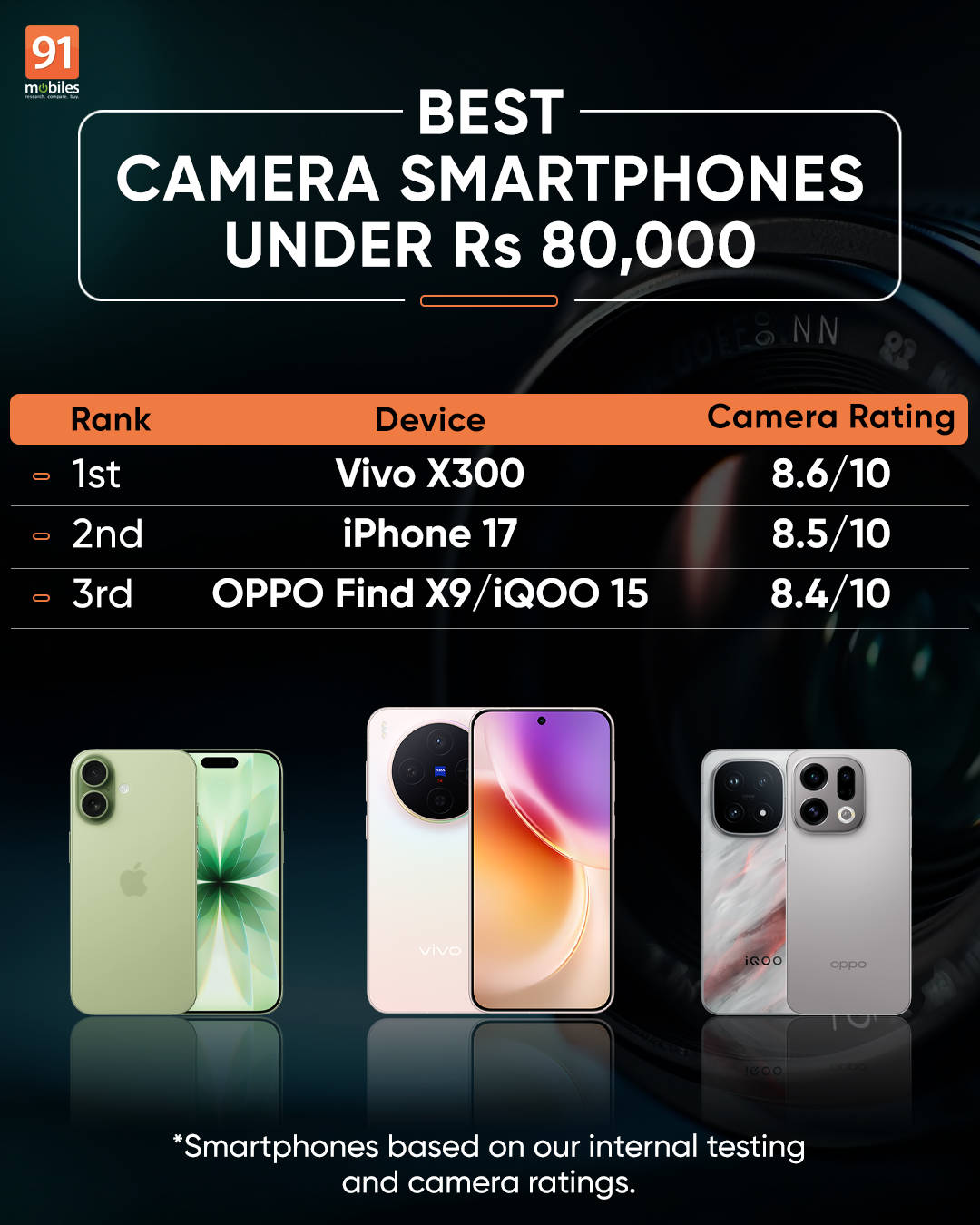
Runners-up: At second spot is the iPhone 17 (review), and it delivers excellent photos with sharp detail, accurate colours, and reliable performance in both daylight and low light. Portraits, especially at 2x, look stunning with natural background blur and strong subject separation, making the missing telephoto lens far less noticeable.
At third place we have a tie between the Realme GT 8 Pro (review) and the iQOO 15 (review). The Realme GT 8 Pro is the better choice if you prioritise zoom and portrait shots. Its 200MP telephoto camera is the clear advantage, delivering consistently sharp, detailed shots with pleasing colours across most lighting conditions, while the main camera, ultra‑wide, and selfie shooters are good but inconsistent in focus, sharpness, and low‑light performance.
The iQOO 15, on the other hand, delivers vibrant, punchy images with reliable exposure and dynamic range across its cameras and offers good video performance with stabilised, colour‑accurate 4K footage. Portraits look natural and low‑light shots are handled well, though the selfie camera is weaker and there is no dual‑view mode.
Best flagship camera phones
Winner: Vivo X300 Pro
| Best Camera Phones | 91mobiles Camera Rating |
| Vivo X300 Pro | 8.7/10 |
| Galaxy S25 Ultra/OPPO Find X9 Pro | 8.6/10 |
| iPhone 17 Pro Max | 8.5/10 |
The Vivo X300 Pro (review) refines an already strong camera formula, and comfortably tops the flagship category. It delivers excellent daylight photos with rich detail, wide dynamic range, and natural-looking skin tones, and its 2x crop and portrait mode produce images that are ready to share with minimal tweaking.
The telephoto camera is the real differentiator, offering crisp, contrasty zoom shots that remain usable even at longer focal lengths, while the ultrawide is sharper and more consistent than before, and the new autofocus selfie camera is a big upgrade. Low-light performance and video are both strong overall, with only minor quirks that do not undermine the overall experience.
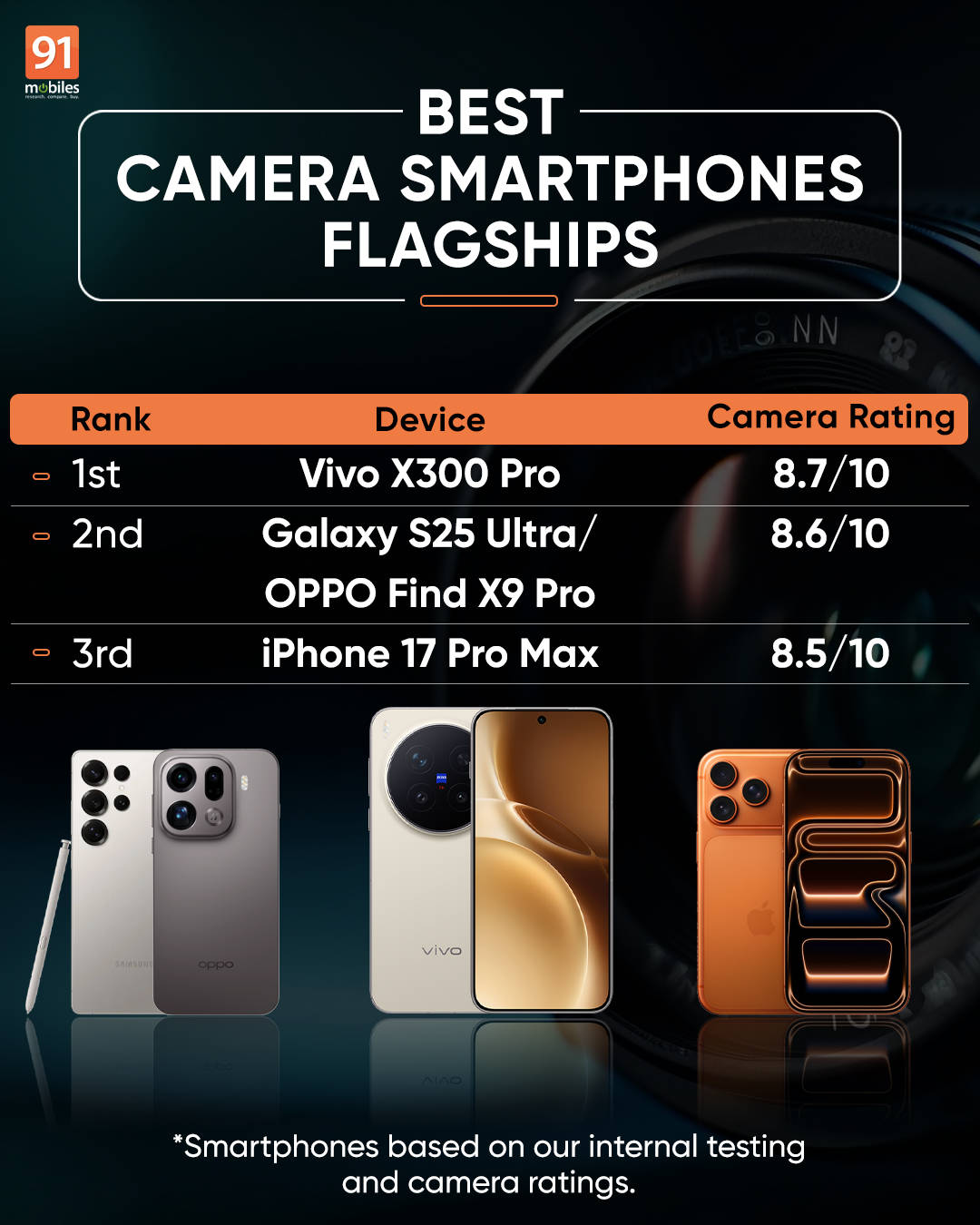
Runners-up: The second position is a tie between the Samsung Galaxy S25 Ultra and OPPO Find X9 Pro. The Samsung Galaxy S25 Ultra (review) is a fantastic all-around camera phone, delivering sharp ultra‑wide photos, accurate skin tones in portraits, and reliable low‑light results, though images can look slightly warm at times, and selfies are not the most detailed.
The OPPO Find X9 Pro (review) is impressive with detailed, vibrant images, balanced dynamic range, and creative modes like XPan, but it can crush some shadows, produce softer selfies, and occasionally struggle with slower processing and focus, issues that could improve with software updates.
At the third spot is the iPhone 17 Pro Max (review), which continues Apple’s reputation for top-tier cameras, with its trio of 48MP rear shooters delivering excellent detail, colour, and a much-improved telephoto that now offers usable 8x zoom, even if it still cannot match the extreme zoom of some rivals.
The upgraded front camera is a highlight, with its clever square sensor enabling effortless portrait or landscape selfies and automatic orientation, while image quality and video capabilities remain outstanding, making this one of the best phones for creators.