Best Peripherals reviewed this quarter across price ranges


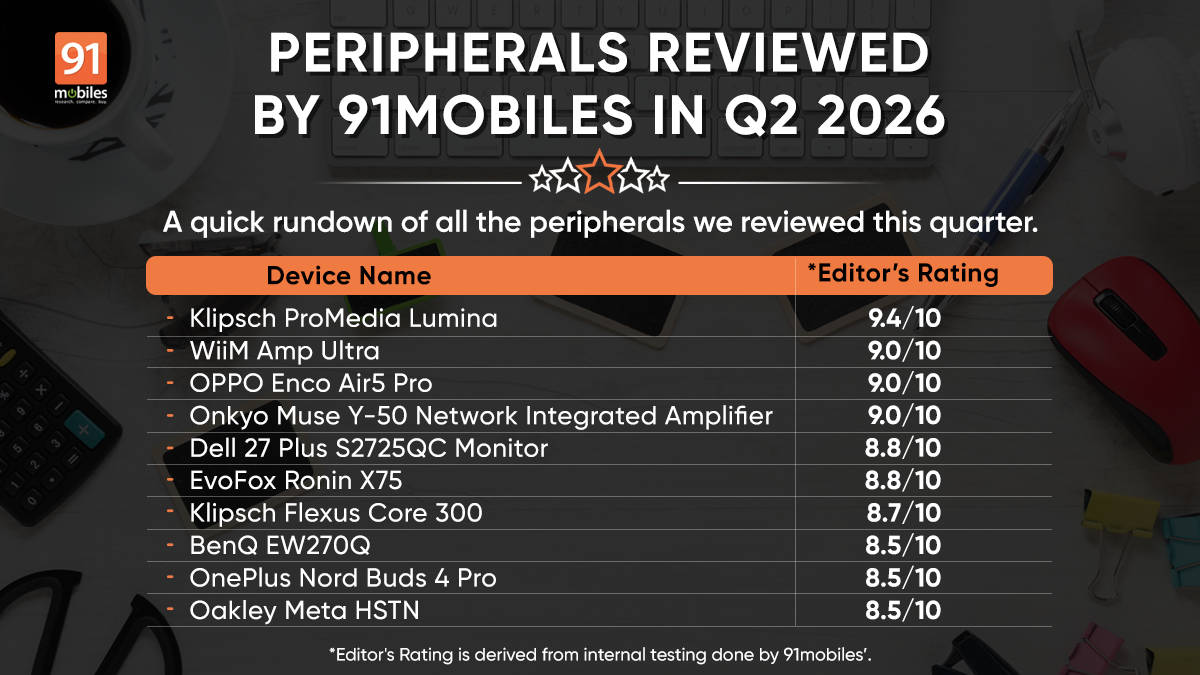
Thirty peripherals across three months. This quarter (April – June) covered everything from a Rs 2,199 Bluetooth speaker to a Rs 99,990 soundbar with first-of-its-kind Dirac Live room correction, with TWS earbuds, gaming monitors, smartwatches, mechanical keyboards, streaming amplifiers, smart glasses, and a health ring in between.
The clearest theme was value moving upward faster than price. The EvoFox Ronin X75 puts gasket-mount keyboard acoustics under Rs 5,000. The OPPO Enco Air5 Pro puts 55 dB ANC and Hi-Res audio under Rs 5,000. The CMF Watch 3 Pro puts dual-band GPS in a sub-Rs 10,000 smartwatch. Each would have required twice the budget as recently as 2024.
At the premium end, the BenQ MOBIUZ EX271QZ, a 27-inch 2K QD-OLED at 500Hz, is the quarter’s most technically distinctive product. Not everything landed cleanly: the HUION Note E has hardware that earns its price and software that does not, and the Noise Master Buds 2 have a fit issue worth knowing about before buying.
Klipsch ProMedia Lumina


The ProMedia Lumina is the most sonically accomplished desktop speaker system we reviewed this quarter. The satellite speakers use Klipsch’s Microtractrix horn with a 1-inch tweeter and 3-inch midrange driver. The compact MDF subwoofer houses a 6.5-inch side-firing woofer. The output is genuinely cinematic for a desktop footprint, and the Klipsch Control app adds 6-band EQ, Night Mode, and input switching. The two limitations to know about: the satellite-to-subwoofer cables use proprietary connectors that cannot be swapped for standard speaker wire, and there is no HDMI eARC for TV connection.
Editor’s Rating: 9.4 / 10
Pros
- Sublime Audio Quality
- Premium Build & Design
- Robust App Integration
- Customizable RGB Lighting
- Compact Subwoofer
Cons
- Proprietary Cables
- Basic Bluetooth Codec
Read the full review here
WiiM Amp Ultra


The Amp Ultra replaces a standalone streamer, DAC, and amplifier in a single chassis. Roon Ready certification, Hi-Res audio up to 24-bit/192kHz, AirPlay 2, Chromecast, Spotify Connect, and TIDAL Connect are all on board. Output is 120W per channel into 4 ohms. Build quality and app support are both strong. For anyone with passive speakers who wants a clean, capable, and well-supported streaming stack, this eliminates three devices and their cables in one purchase. The best all-in-one streaming amp available in India under Rs 50,000.
There are a few drawbacks, such as the limited advanced room correction and no headphone out/phone input.
Editor’s Rating: 9 / 10
Pros
- Excellent value for performance
- Stable, intuitive app experience
- Strong wireless connectivity
- Clean, balanced sound signature
Cons
- Limited advanced room correction
- AirPlay seekers will be left wanting
- No headphone out/phono input
Read the full review here
OPPO Enco Air5 Pro


OPPO returned to the Enco Air lineup after three years and immediately set a new benchmark for the sub-Rs 5,000 segment. The 55dB ANC Rating holds up in real-world use: traffic noise, train tunnels, and office chatter all dropped to near-silence in testing. It has 54 hours of battery.
The 12mm titanium-coated driver delivers a V-shaped sound signature, strong highs and lows, slightly recessed mids, that suits most popular genres. LHDC 5.0 delivers Hi-Res audio on compatible phones. Bluetooth 6.0, dual-device pairing, and an IP55 Rating complete a package that leaves the competition with very little to point to.
Editor’s Rating: 9 /10
Pros
- Great ANC
- Full-bodied, exciting sound quality at Rs 4,999.
- Solid battery life
- Premium matte case finish
- Bluetooth 6.0 with dual-device connectivity
Cons
- Mids are slightly recessed
Read the full review here
Onkyo Muse Y-50 Network Integrated Amplifier


Onkyo’s return to India under the Premium Audio Company umbrella, and it makes a strong case. The Axign Class-D module produces none of the grain or sterility associated with the topology. The Y-50 sounds energetic, poised, and muscular, with a wide soundstage and a solid centre image.
At 250W into 4 ohms, it drove a pair of KEF Blade 2 Metas without complaint. Connectivity is comprehensive: three RCA inputs, HDMI ARC, a dedicated MM/MC phono stage, subwoofer output, and full streaming via Spotify Connect, TIDAL Connect, Qobuz Connect, and AirPlay 2. The front display doubles as a VU meter, which is a nice touch. The remote is a cluttered relic, and the display should have been a touchscreen, minor gripes around an otherwise coherent package.
Editor’s Rating: 9 / 10
Pros
- Commanding power easily drives large speakers
- Plenty of physical and wireless connection options
- Useful display features analogue-like VU meters
Cons
- Large screen completely lacks touch capabilities
- Included remote control is excessively cluttered
- Bluetooth limits streaming to basic codecs
Read the full review here
Dell 27 Plus S2725QC Monitor

A 27-inch 4K IPS monitor at 120Hz with a USB-C port that delivers 65W charging. The ash-white design is genuinely attractive and pairs naturally with premium laptops. 4K at 27 inches produces excellent text sharpness for productivity work. The 120Hz panel makes everyday navigation noticeably smoother than 60Hz. HDMI 2.1 and VRR allow clean PS5 and Xbox Series X connection. The limitations are typical IPS: contrast is unremarkable, and HDR without local dimming produces grey rather than black in dark scenes. Not for competitive gaming.
Editor’s Rating: 8.8 / 10
Pros
- Sharp and vibrant 4K IPS display
- Smooth 120Hz refresh rate for work and gaming
- Excellent USB-C connectivity with 65W charging
- Surprisingly good built-in speakers
Cons
- HDR performance feels underwhelming
- Not ideal for competitive esports gaming
Read the full review here
EvoFox Ronin X75

A 75% layout mechanical keyboard with gasket mounting and five-layer sound dampening at Rs 4,999. That combination typically appears at Rs 8,000 and above. The result is a keyboard that sounds noticeably deeper and softer than anything competing at this price, with a thocky keystroke that mechanical enthusiasts spend considerably more chasing. Tri-mode connectivity covers USB-C, 2.4GHz wireless, and Bluetooth, with a 1000Hz polling rate in wired and wireless modes. The 4,000mAh battery lasts several days with RGB enabled, although the RGB brightness could have been better along with the keycap finish.
Editor’s Rating: 8.8 / 10
Pros
- Excellent typing feel with gasket mount and dampening
- Smooth, pre-lubed switches with minimal scratchiness
- Versatile tri-mode connectivity
- Great value with solid accessories and features
Cons
- RGB lacks brightness and punch
- Minor keycap legend and finish inconsistencies
Read the full review here
Klipsch Flexus Core 300

The Klipsch Flexus Core 300 is the world’s first soundbar with built-in Dirac Live room correction. The Core 300 packs 13 drivers into a 54-inch chassis, including horn-loaded tweeters, side and top-firing drivers, and a pair of 4-inch subwoofers per side, making an external subwoofer optional for most content.
With Dirac engaged, the midbass cleans up noticeably, restoring the spaciousness and air you would expect from a traditional stereo setup. Without it, the sound is thick in the low-mids. The walnut veneer and aluminium grille finish is genuinely premium. Connectivity covers HDMI 2.1 passthrough, eARC, Spotify Connect, TIDAL Connect, and AirPlay. The remote lacks a Dirac on/off toggle, which becomes a minor frustration when making comparisons.
Editor’s Rating: 8.7 / 10
Pros
- Beautiful finish adapts to any decor
- Spacious, authoritative, clean sound
- Built-in Dirac Live
- Ease of use and connectivity
Cons
- Substantial width and weight
- Dynamics are a bit tame
- Remote lacks Dirac on/off
Read the full review here
BenQ EW270Q

A 27-inch 1440p IPS monitor at 200Hz is a combination that makes the BenQ EW270Q genuinely useful for both productivity and gaming without compromising either. The IPS panel delivers accurate colour coverage suitable for photo editing and content consumption.
At 200Hz, competitive titles feel responsive and fluid. The BenQ Color Shuttle app adds game-specific colour profiles that are more useful than they sound. HDR support is present but limited without local dimming. The strongest single-display solution in the sub-Rs 20,000 monitor segment.
Editor’s Rating: 8.5 / 10
Pros
- Excellent balance of 200Hz gaming and QHD productivity
- USB-C with 65W power delivery enables a clean single-cable setup
- Good colour reproduction and sharp text clarity
- Surprisingly capable built-in speakers
Cons
- No height adjustment on the stand
- HDR performance is limited and not true HDR
- Competitive gamers may prefer ZOWIE monitors
Read the full review here
OnePlus Nord Buds 4 Pro


The easiest TWS recommendation under Rs 4,000 in India right now. The 12.4mm titanium-coated dynamic driver produces clear, balanced sound with good mid presence, something many competitors at this price sacrifice for bass. ANC is strong for the segment. Total battery life reaches up to 44 hours with the case. Bluetooth 5.4 connectivity is stable. The companion app handles EQ and ANC mode control without friction. A small negative for the TWS is the lack of proper mids.
Editor’s Rating: 8.5 / 10
Pros
- Likeable design
- Punchy, engaging, and customisable sound
- Effective ANC for the price
- Excellent battery life
Cons
- BassWave feels redundant next to Bass mode
- Mids could have been better
Read the full review here
Oakley Meta HSTN

A collaboration between Meta’s Ray-Ban smart glasses platform and Oakley’s sport optics. Two 12MP cameras, five-microphone audio, open-ear speakers, and Prizm lens technology in Oakley’s O-Matter sport frame.
The camera output is genuinely usable, not just functional. Meta AI integration for quick answers and image description works as advertised. The sport frame makes this more comfortable during active use than the standard Ray-Ban Meta. Of course, the price is a point of contention for some, and the design may not appeal to all.
Editor’s Rating: 8.5 / 10
Pros
- Stylish & sporty
- Decent image quality
- Good audio
- Useful AI prowess
Cons
- Pricey
- Design might not appeal to everyone
- Shot framing can be problematic
Read the full review here
Fire TV Full HD Streaming Stick (2026)
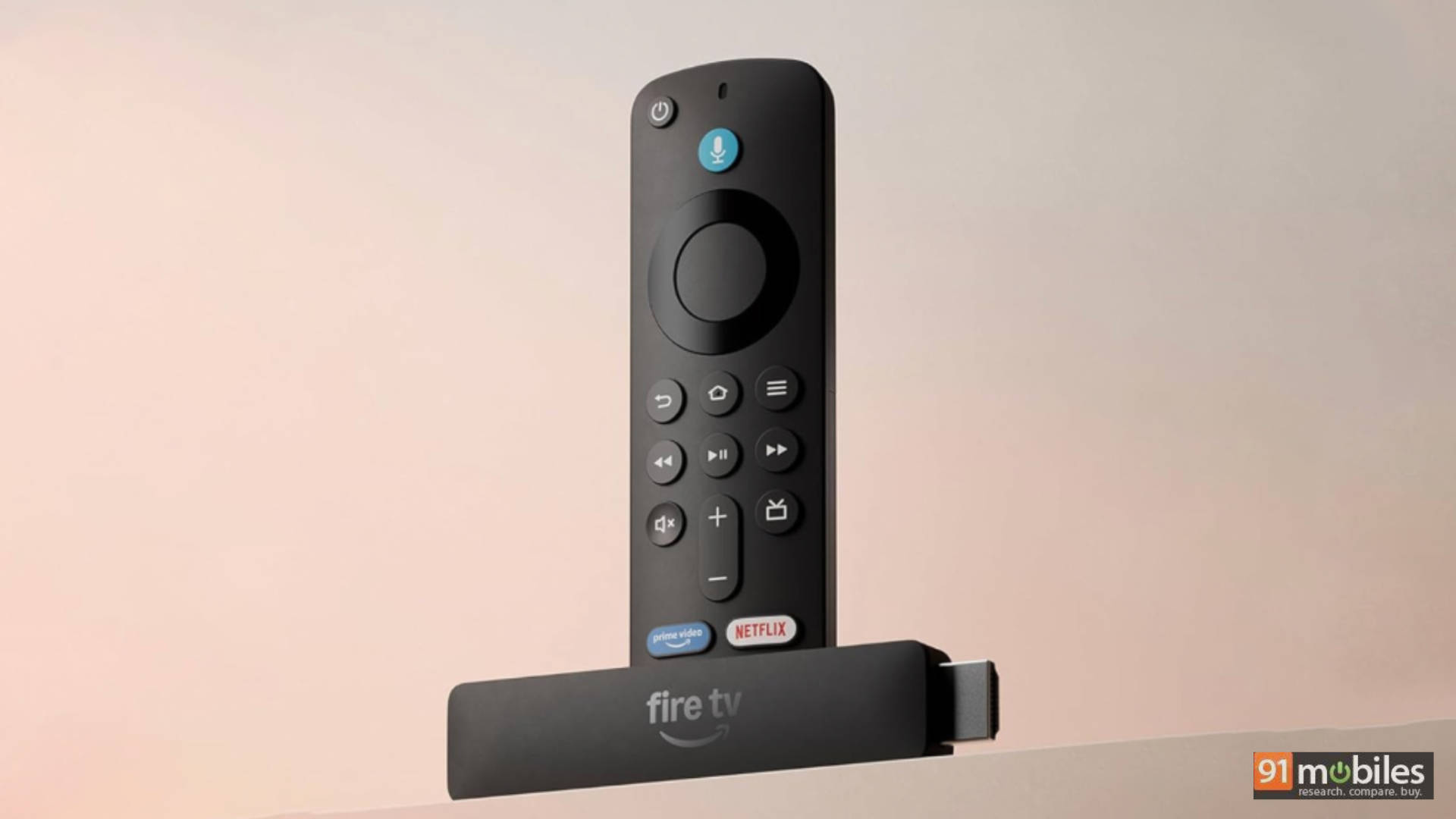
30% slimmer than the previous generation and now USB-powered from the TV itself, eliminating the wall socket requirement. The new Vega OS is clean and fast, but it removes APK sideloading, a significant trade-off for users who relied on that. Wi-Fi 6 keeps streams stable. HDR10 and HDR10+ support improves content on compatible displays. The stick tops out at 1080p, making it the right choice only for HD displays or secondary screens and is redundant for newer TVs. Anyone with a 4K TV should spend the extra Rs 1,000 on the 4K Select.
Editor’s Rating: 8.5 / 10
Pros
- Wi-Fi 6 and HDR10+ support
- Genuinely useful companion app
- Powers directly via TV’s USB
Cons
- Caps out at 1080p HD
- No OTT logo on thumbnails
- Redundant on newer smart TVs
Read the full review here
TP-Link Deco BE25 (3-pack)

The most accessible Wi-Fi 7 mesh system in India. The three-pack covers a large area, each node carries two 2.5 Gbps ports, and setup via the Deco app takes minutes. In testing on a 200Mbps connection, it delivered near-full speeds in every room, with stable connectivity even for cameras placed on a balcony and a floor below.
The Deco app adds QoS, guest network, IoT isolation, and parental controls. Advanced HomeShield security features sit behind a paid subscription. No 6GHz band and no web interface are the two honest limitations for power users.
Editor’s Rating: 8.5 / 10
Pros
- Easy to set up
- Large coverage area
- Supports Wi-Fi 7 & up to 150 devices
- Lots of useful features
Cons
- No web interface
- Advanced security features are paid
Read the full review here
EarFun Air Pro 4+

The Air Pro 4+ carries the Snapdragon Sound certification and delivers on it. Sound is rich, detailed, and consistent across genres, with good instrument separation and a wide soundstage for the price. Bass is punchy without dominating the mix. ANC handles background environmental noise well but leaves voices at close range audible, which is the one area where it falls short of expectations. Call quality is good. Battery life is competitive at around 9 hours per earbud. The best Hi-Res wireless earbuds available in India under Rs 10,000.
Editor’s Rating: 8.5 / 10
Pros
- Great sound quality
- Advanced codec support
- Loaded with features
- Good battery life
Cons
- ANC could be better
- Touch controls are iffy
Read the full review here
Amazon Echo Dot Max

Amazon’s most capable Echo Dot and the only one with a built-in Zigbee hub, Thread border router, and Matter support. The 2.5-inch woofer delivers more bass than the standard Echo Dot. The Omnisense sensor adds temperature, ambient light, and ultrasound presence detection for home automation triggers. For smart home users building a Zigbee or Matter network, the ability to control devices without a separate hub is a genuine convenience gain. The limitation here is that the price tag still remains a bit high for what it offers.
Editor’s Rating: 8.5 / 10
Pros
- Audible acoustic upgrade with deeper bass.
- Native Zigbee, Thread, and Matter hub.
- Proactive room automation via Omnisense radar.
Cons
- High price tag for mono sound.
- Alexa response speeds remain unchanged.
Read the full review here
Tribit PocketGo


A compact Bluetooth speaker that produces louder, more full-bodied sound than its size suggests. The 10W driver is well-tuned, IPX7 waterproofing is genuine, and the 24-hour rated battery held up in testing. Bass extension and soundstage width are constrained by physics at this size, and that is expected.
The XBass mode adds low-end presence at the cost of some mid clarity. For a bathroom or day-bag outdoor speaker, this is hard to beat at the price. There are limitations as well, though, with this being a single-driver speaker and the charging speeds a bit on the lower side.
Editor’s Rating: 8.4 / 10
Pros
- Extremely compact
- Solid build quality + durability
- Impressive sound quality for the price
- Tribit app with EQ customisation
Cons
- Single driver limitations
- Modest charging speed (around 3 hours)
Read the full review here
BenQ MOBIUZ EX271QZ


A 27-inch 2K QD-OLED monitor at 500Hz. The QD-OLED panel delivers self-illuminating blacks and infinite contrast alongside 99% DCI-P3 colour coverage. Spend time with the BenQ Color Shuttle app, which downloads game-specific colour profiles from BenQ’s server, and the picture quality climbs to a level that is difficult to describe in spec terms alone. Anti-burn-in features including Pixel Orbit, Idle Dimmer, and Logo Dimming run quietly in the background. At Rs 84,998, the positioning is specific: for buyers who want the maximum refresh rate combined with OLED panel quality, there is currently no alternative.
Editor’s Rating: 8.4 / 10
Pros
- Gorgeous QD-OLED panel
- Blistering 500Hz refresh rate
- Excellent HDR performance
- Colour Shuttle app support
Cons
- Premium price tag
- Overlaps awkwardly with BenQ EX271UZ
- Niche appeal
Read the full review here
HUION Note E


An 8.4-inch Android 15 digital notebook with an anti-glare nano-etched LCD panel that mimics the tactile feel of paper. It is not e-ink, the colour LCD is faster and more vibrant, but the matte surface makes writing with the PenTech 3.0 stylus genuinely close to pen on paper. The battery-free magnetic stylus with 8,192 pressure levels is excellent. The hardware earns its price, but it has average speakers and slow charging is something that holds it back.
Editor’s Rating: 8.3 / 10
Pros
- Compact and portable
- Effective anti-glare display
- Engaging writing experience
- Bundled PW510 pen
Cons
- Average speakers
- Slow charging speed
Read the full review here
Realme Buds T500 Pro

Under Rs 3,000, the Buds T500 Pro is Realme’s most complete TWS offering. The 10mm dynamic driver delivers a warm, bass-forward sound that works well for pop and hip-hop. ANC is solid for the price, IPX4 covers daily use, and battery life holds at around 8 hours per earbud. The companion app adds EQ customisation. The main concession is a plastic build that feels its price, and the spatial audio that could have been a bit better.
Editor’s Rating: 8.2 / 10
Pros
- Exceptional battery life
- Effective ANC for the price
- Sound quality will appeal to most buyers.
- Design is fun and compact
Cons
- Not ideal for all music genres.
- Spatial audio could have been better
Read the full review here
ASUS ROG Strix XG248QSG Ace


A 24-inch 610Hz Fast IPS monitor built for competitive FPS players. The refresh rate is not marketing. At this frame count, motion clarity in Valorant and CS2 is measurably smoother than at 360Hz or 500Hz, and the input lag at this speed is relevant at tournament level. For everyone else, this is a significant amount of money for a 1080p display. The Rs 89,990 price reflects how narrow the audience is, the lack of USB ports on the machine is another drawback.
Editor’s Rating: 8 / 10
Pros
- Ultra-fast refresh rate
- Low input latency
- Sturdy build quality
- Excellent motion clarity
- Windows app for OSD controls
Cons
- Meant for a niche audience
- No USB ports
- Overpriced
Read the full review here
boAt Aavante Prime X

This is boAt’s first premium soundbar and the brand’s most ambitious product to date. The 7.1.4-channel Dolby Atmos configuration with wireless detachable rear satellites and a wireless subwoofer at Rs 39,999 is a genuinely different proposition from anything else at this price. The wireless satellite design is the standout feature: the rear speakers detach from the main bar and run on internal 4,500mAh batteries, making proper surround placement possible without running cables across the floor. Audio performance is strong, with deep bass and clear vocals even in chaotic action scenes. The front Dot Matrix display cannot be dimmed, and individual rear speaker volume calibration is not available.
Editor’s Rating: 8 / 10
Pros
- Versatile design
- Immersive sound
- Ample connectivity options
- Easy setup
Cons
- Display can’t be dimmed or turned off
- Limited Calibration for rear speakers
- Echo Effect requires manual intervention
Read the full review here
CMF Watch 3 Pro


Nothing’s most refined budget smartwatch. The 1.43-inch AMOLED at 670 nits is sharp and readable outdoors. Dual-band L1+L5 GPS locks in seconds and tracks accurately, a feature typically found in watches at twice the price. Battery life runs well past a week in mixed use. The Nothing X app is well-designed, and 131 sport modes cover essentially every activity. The swappable bezels from the Watch Pro 2 are gone, which is a step back. No NFC means no contactless payments, and the watch is IP68 rated but not cleared for swimming.
Editor’s Rating: 8 / 10
Pros
- Bright AMOLED display
- Smooth and responsive
- Reliable tracking
- Strong battery life
Cons
- Strap comfort issues
- Some features need refinements
- No Swim tracking
Read the full review here
Klipsch Miami

A large party speaker that takes a different approach to the category. Where most competitors in this segment lead with maximum bass, the Miami uses a horn-loaded compression tweeter with dual 5.25-inch woofers to prioritise clarity and balance. The Ultra Bass mode and in-app EQ offer flexibility for those who want more low-end, and there are plenty of connectivity options
At around 18kg with trolley wheels and a retractable handle, it is portable in the luggage sense rather than the backpack sense. IPX4 covers light splashes but not poolside use. The bundled microphone is functional but lacks clarity at high volumes. The battery life is a weakness, while the price could be better.
Editor’s Rating: 8 / 10
Pros
- Solid build, practical design
- Clean, balanced, and loud sound
- Useful EQ and Ultra Bass modes
- Versatile connectivity
Cons
- A bit pricey
- Battery could have been better
- Average app experience
Read the full review here
Wzatco Yuva Go Ultra

A compact Google TV projector with 1080p native resolution, auto focus, and 4-point digital keystone correction. In dark rooms, the image is sharp and vibrant across 40 to 200 inches. Auto focus and keystone correction require minimal manual adjustment after initial setup. Google TV provides full Play Store access and clean streaming integration. The honest limitations: claimed brightness is undermined by any ambient light, and Bluetooth audio pairing suffers from latency that made it impractical for video viewing during testing. The aux port also failed to output audio in our unit.
Editor’s Rating: 8 / 10
Pros
- Compact, lightweight
- Reliable auto focus and keystone correction
- Sharp visuals in dark rooms
Cons
- Audio quality could have been better
- Noticeable Bluetooth latency
Read the full review here
UltraProlink Boost Unity 105W

A six-port GaN desktop charging station delivering up to 105W total output via 5th-generation GaN technology. It has four USB-C ports, two at 100W and two at 65W, alongside two USB-A ports at 18W each. Supports AVS for iPhone 17, PPS up to 105W for laptops, Samsung SFC 2.0, and QC 3.0/4.0. At Rs 6,999, it replaces multiple chargers on a desk with a single BIS-certified unit. However, it does not come with a charging cable included in the box.
Editor’s Rating: 8 / 10
Pros
- Can charge up to 6 devices
- Fast charging
- Supports multiple protocols
- Safety features
Cons
- No charging cable included
Read the full review here
Realme Watch S5

Realme’s most well-rounded smartwatch. The 1.43-inch AMOLED at 1,000 nits is vivid and readable in direct sunlight. Independent GPS covers 110 sport modes. Battery life reaches up to 16 days in standard mode, among the best in the segment. Heart rate, SpO2, sleep, stress, and women’s health tracking are all present. Two honest concessions: the UI displays time in 24-hour format in menus even when the main face is set to 12-hour, a software inconsistency, and the haptic feedback is not the best.
Editor’s Rating: 7.9 / 10
Pros
- Bright and vivid AMOLED display
- Elegantly designed and lightweight
- Exceptional battery life
- Accurate tracking with loads of workout modes
Cons
- Software requires polish and refinement
- Haptic feedback could’ve been stronger
Read the full review here
WD Black P10 Game Drive (6TB)

The P10 solves one problem cleanly: running out of console storage. The rugged corrugated metal chassis keeps the 5,400 RPM drive cool under sustained use. Sequential read and write speeds average around 120 to 130 MB/s, adequate for archiving and loading last-gen titles. It is not fast enough to run native PS5 or Xbox Series X games those still require an internal SSD. The Micro-B USB connector is the most dated element on an otherwise well-suited product. Plug-and-play with both PS5 and Xbox.
Editor’s Rating: 7.8 / 10
Pros
- Massive 6TB capacity for game hoarding
- Stays remarkably cool under pressure
- Rugged, container-chic metal design
- 3-year limited warranty
Cons
- The archaic Micro-B port is a proper faff
Read the full review here
Qubo Q400 Air Purifier

The Q400 is an IoT-connected air purifier with PM2.5 monitoring, Alexa compatibility, and a responsive app. The hardware is competent: quiet at lower speeds, adequate coverage for a mid-sized room, and clean smart home integration. The harder question the review raises is sensor accuracy. Without independent calibration data, the PM2.5 readings are difficult to act on with real confidence. For a product where the data is the core value proposition, that gap matters.
Editor’s Rating: 7.7 / 10
Pros
- Competitively priced at Rs 8,990
- Manages to rid the space of foul smells
- Quiet operation
Cons
- The Qubo app only connects to a 2.4GHz Wi-Fi network
- Fires directly upwards, so it cannot be used as a fan
- App disconnection issues
Read the full review here
Noise Master Buds 2

Sound by Bose tuning, 51dB adaptive ANC, LHDC Hi-Res audio, Bluetooth 6.1, and 360-degree spatial audio with head tracking at Rs 7,999 is a strong specification on paper. The sound quality delivers balanced, musical, and detailed audio without the over-boosted bass common in this segment. ANC is effective, and the battery life is also pretty decent for the price. The fit is the honest problem: the larger earbud size causes discomfort in some ear shapes after 30 to 40 minutes of extended wear.
Editor’s Rating: 7.5 / 10
Pros
- Segment’s best noise cancellation
- Impressive sound
- Good battery life
- LHDC 5.0 support
Cons
- Slightly uncomfortable earbuds design
- Case design
Read the full review here
Moto Buds 2 Plus

Sound by Bose tuning, an 11mm dynamic driver with Knowles balanced armature, 40-hour total battery life, Bluetooth 6.0, and LHDC Hi-Res audio at Rs 5,999. The comfort is genuinely good, a secure fit that holds through extended sessions without fatigue. Sound quality is pleasant but stops short of what the Bose association implies: bass lacks punch and depth, and the overall output feels constrained relative to what the hardware suggests it should deliver. There’s also no iOS app for this.
Editor’s Rating: 7.5 / 10
Pros
- Comfortable and compact design
- Great battery life
- App customisation
- Decent ANC
Cons
- Sound quality could be better
- No app for iOS
Read the full review here
Oura Ring 4

The Oura Ring 4 is the most discreet health wearable on the market, and the most accurate passive sleep tracker we have tested. The titanium ring packs heart rate, SpO2, skin temperature, and HRV sensors in a form factor that is comfortable enough to wear continuously. Readiness and Sleep scores correlate well with subjective wellbeing over time. The ongoing Rs 499 per month subscription sits behind the most meaningful data, which is the honest limitation of the ownership model. The hardware costs Rs 24,990; the full value of the platform costs more. Also, the app AI needs to be tuned better
Editor’s Rating: 7 / 10
Pros
- Durable and premium build
- No bumps on the inner lining
- Plenty of finishes and sizes
- App is really well curated
- Detailed breakdown of sleep
Cons
- Monthly subscription adds to the expensive ring cost
- Competition doesn’t have subscription
- Four colours are Rs. 11,000 more for no reason
- App AI needs to be better
Read the full review here